10/07/2010

Requiem for a record collection

Over the years I accumulated, at a guess, maybe a thousand vinyl LP's, starting in about 1983, with my purchases finally dwindling to zero in about 1995. A cull some years ago cut them down to only seven hundred or so. I bought rock, heavy metal, and a lot of Seventies stuff. At the time, like many people I knew then and know now, I was appalled at having to live through the Eighties with its manifold crimes against music and fashion. I retreated into squalling guitar and high-pitched vocals following a trip to an Iron Maiden concert in...1982, possibly 1983. It seemed the sensible thing to do. At some point I bought a guitar and set about learning to play it. These, plus a subscription to Interzone, pretty much kept me sane until the start of the Nineties.

By the end of the Eighties I'd taken up writing for the first time since my early teens, more or less given up playing guitar, and was buying fewer and fewer records. The last album I ever bought in vinyl, I think, was White Zombie's Astro-Creep 2000 sometime around 1995. By that time I'd gone to dozens, more likely hundreds of gigs, but as the Nineties progressed I attended less and less. Even so, as I moved into different flats in and around Glasgow's West End, sharing with different people under different circumstances, I hauled my ageing record deck and vinyl albums after me, even though I rarely listened to them any more. They finally stopped being moved around when I used a fat chunk of the money I received for Angel Stations to place a deposit on a flat in the early '00's. The records went into a cupboard, along with the stereo, and they've remained there ever since.

I could listen to music, perhaps, when I'm writing - as many do - but I'm one of those who finds any kind of sound above a barely audible murmur tremendously distracting during the creative process. Most of the time, I write in total silence. Sometimes I listen to SomaFM.com's 'drone' channel, to get a certain mood, but even that only very occasionally.

Of course, I don't need a vinyl collection any more. About ten years ago I burned a significant chunk of them to MP3 format, and still have them ready for whenever I want to listen to them. Even that isn't necessary any more, since I can usually find pretty much anything I want to on either Spotify or Grooveshark, and in seconds.

At the moment, a few feet away from me are my signed Joe Satriani albums, purchased sometime in the late Eighties. Also the first album by Faith No More - I have a very vivid memory of hearing We Care A Lot for the first time in my kitchen, on the radio, circa 1988, and thinking it was a sign that the Eighties were finally, thankfully, on their way to the trashbin of history. I felt vindicated when Nirvana appeared on the scene. It isn't just that Nirvana were a good band - they were necessary, within the context of the time. There are albums by Budgie, acquired at various record fairs throughout the Eighties when I went through a blues-rock phase - and their stuff still holds up (some of you might be interested to know they were enormously influential on Metallica, who even recorded an EP of four Budgie tracks sometime in the mid-Eighties). There's an album by Tomita, a delightfully weird-sounding Japanese solo electronica artist, left behind at my house by a friend of a friend. It sat around for a year before I listened to it, and it turned out to be superb (Snowflakes Are Dancing, if you're wondering).

Then there's Jeff Wayne's War of the Worlds (of course), and albums by various goth bands like The Nephilim and The Mission who, for some inexplicable reason, I really rated about two decades ago. A shedload of Zeppelin and Sabbath and...it goes on.

Anyway. A couple of years in the Far East does wonders for breaking the bond between a man and his vinyl collection, especially if he doesn't even own a stereo to play them on any more. That makes the vinyl so much useless dead weight. But, it still has some emotional value to me, hence this entry. Sometime in the next week or two I'm going to call a local record shop to come around and make me an offer on them. Given the experience of others, I think it's fair to say I'm not anticipating getting very much money for them at all, but to make myself feel better about it I'm putting whatever I get towards eventually getting myself an Ipad.

Original vinyl of first Jane's Addiction album, complete with ribbed rubber sleeve (because the record shops freaked at the actual cover)

 First got this Steve Vai album after hearing a track of his that came on a flexi-disc with Guitar magazine in 1984. Ran out and got this. It's still insanely brilliant - not something I can say, unfortunately, for the vast majority of his output since then.

 Hum a couple of bars from this at any sf convention, and the convention will hum back. Uuuuu-lah!

I first heard about Roy Harper when I found out from a friend he was the subject of the song Hats off (to Roy Harper) on Led Zeppelin's third album. He also sang on Have a Cigar on Pink Floyd's Wish You Were Here. Naturally, when I found out Harper had collaborated on an album with Jimmy Page, I had to have it.

It took me a while to get into Hawkwind, but a friend at school was a stone-cold Hawkwind fan. I got into them just as he was getting out of them. Not only that, they're playing Glasgow later this year, and with any luck I'll be there. 

More Hawkwind - the first album by them I ever owned, given to me by the same school friend. It's still my favourite. 

Picked this Al Di Meola album up when I was going through a major phase of buying albums by guitarists. It cost about a quid out of a bargain bin and remains one of my favourites. It's superb. 

 First Led Zeppelin album I ever bought ...

and the Faith No More album I bought about five minutes after hearing We Care A Lot on the radio. 

I first heard Stevie Ray Vaughan when I saw him play on the (Sunday?) morning at the Reading Rock Festival in, er...1984? The one with the Black Sabbath gig that directly inspired the 'Stonehenge' scene in Spinal Tap, anyway. I remember walking across a field feeling very tired and hearing somebody playing Third Stone from the Sun note-perfect. I just stood and gaped, and bought this album the first day I was back in Glasgow.   

And that's my record collection in its entirety, shoved into a cupboard next to my front door. Sigh.

9/30/2010

The cover for Final Days


"Final Days follows the lives of a few key characters as a cataclysmic event is unleashed in Earth’s near future. This is a twenty-third-century thriller revolving around the slow uncovering of a conspiracy that irrevocably dooms the Earth, set against a backdrop of interstellar colonies. The story takes advantage of current cutting-edge ideas about the creation of artificial wormholes for interstellar travel, and their implications for practicable time travel. Action-packed and fast-paced, this is a thrilling SF adventure and a wonderful start to Gary’s new series."

So there you go: the new cover at last. I saw an earlier version of the full wraparound image a few days ago, but was asked to hold back until they'd made a final decision on a few bits and pieces and, particularly, the font. I'll have to be honest that I'm slightly surprised by their choice of font, since I thought the other font used looked a lot smarter, but I suspect people's attention will be much more drawn to Steve Stone's quite stunning illustration.

I'll try and score the full wraparound cover from Julie at Pan Macmillan, but if they don't have it, I'll post up the previous version so you can at least see the art in all its panoramic glory.

9/24/2010

The shift to ebooks, redux

You'll recall I mentioned a couple of entries ago that I'd signed up to a website (novelrank.com) that purported to give me a reasonable estimate of the sales of my books on Amazon in a number of territories, and that if those figures were in any way accurate, then the ebook editions of my books were outselling the physical editions, sometimes by quite a considerable percentage. That seems to be borne out by this recent article in The Bookseller ('Ebook sales begin to cannibalize print':

"The data, released as part of a seminar held yesterday with Enders Analysis, 'Digital Seminar: e-books and their impact on the market', showed genres such as science fiction and romance are “overperforming” thanks to the tastes of early adopters of e-books. For example, the e-book market share of the science fiction and fantasy sector globally for the 10 weeks since June was 10%, more than treble the genre’s market share of print book sales. The share taken by romance and saga books was 14%, seven times its print market share."

Which does seem to suggest that the observation of my ebook sales, as being notably higher than my paperback or hardback sales, isn't too far off the mark.

9/19/2010

Hands up if you think the Moon has no gravity

I don't usually have a problem with artistic licence in movies and TV shows, but sometimes there are limits.

I can just about deal with the spaceships in Star Wars rumbling or making pew-pew noises when they shoot at each other because it is, essentially, a fantasy - or at least, that's how I always managed to suspend my disbelief, even though when I first saw them as a kid I'd read enough Clarke and Asimov and Heinlein and popular science texts to know there was no air in space to transmit sound. I can let a lot of things slide, as a matter of fact, but every now and then I run up against something that really takes me by surprise; like discovering that some people think the Moon has no gravity, or that the long, whizzy blue tunnels  like cosmic spaghetti that usually act as stand-ins for hyperspatial wormholes in shows and films like Stargate and Contact are accurate renditions of the same.

I'm damned if I can remember where I read about it, but there was a survey that showed a substantial number of college students in the US thought the moon had no gravity; one question they were asked (I recall) asked them what would happen to a golf ball if an astronaut, standing on the surface of the moon, were to let go of it. Apparently a number of them answered that it would fly away from the Moon and towards the Earth since, presumably, that's where all the gravity in the universe is.

I find this incredibly depressing. I was less than heartened to find out recently that some people, perhaps influenced by TV shows like Stargate, think that a 'wormhole' really is a whizzy blue tunnel of light that could actually be seen stretching across space.

At this point I should probably take a step back and explain just exactly what a 'wormhole' is. Your best source of information is the main Wikipedia article, but I've also copied and pasted the first paragraph here for your benefit; you should also go and check the Wikipedia illustration if you can't quite visualise it.

"In physics and fiction, a wormhole is a hypothetical topological feature of spacetime that would be, fundamentally, a "shortcut" through spacetime. For a simple visual explanation of a wormhole, consider spacetime visualized as a two-dimensional (2-D) surface (see illustration, right). If this surface is "folded" along a (non-existent) third dimension, it allows one to picture a wormhole "bridge". (Please note, though, that this image is merely a visualization displayed to convey an essentially unvisualisable structure existing in 4 or more dimensions. The parts of the wormhole could be higher-dimensional analogues for the parts of the curved 2D surface; for example, instead of mouths which are circular holes in a 2D plane, a real wormhole's mouths could be spheres in 3D space.) A wormhole is, in theory, much like a tunnel with two ends each in separate points in spacetime."

Note the phrase 'essentially unvisualisable structure existing in 4 or more dimensions'.

This matters to me right now because wormholes are what my new book Final Days is all about. That, and time travel (since, you see, if such wormhole tunnels could ever really come into existence, their essential properties would, according to Kip Thorne, until recently the Feynman Professor of Theoretical Physics at CalTech, allow for time travel). But it's not an easy concept to get your head around. I had to spend a couple of days working really, really hard to get my own head around how all of this works before I started on the book. That means I have to take an essentially difficult-to-understand idea and try and explain it to people who've probably, in most cases, never heard of it before. When Hollywood deals with it - as it has - it finds it easiest to portray it as a whizzy blue tunnel of light. It's a metaphor.

Mind you, when you play around with things like wormholes in a story set only a few centuries in the future, you're taking some pretty big leaps of imagination with a concept that is, at best, theoretical. Things like wormhole construction are frankly more likely in the context of a Type 3 Kardashev civilisation than, say, human beings in the 23rd Century. But, as I always like to say, a little over a century ago most people didn't know that the coming years would bring flying machines, nuclear bombs and space craft.

9/13/2010

The shift to ebooks

Here's something of a future shock for you: a couple of months back I signed up to a free online service called NovelRank.com that purports to provide a reasonably accurate estimate of how many copies of a particular title you sell through Amazon on a daily, weekly and monthly basis. This isn't the kind of information Amazon are actually inclined to give away - they still haven't to my knowledge yet given a figure, for instance, on just how many Kindles they've actually sold, for instance - so by means of some comparative algorithm (one assumes) the aforementioned website provides a best-guess figure.

What's interesting about this is that I just checked the sales of the Nova War paperback on that site and assuming it's in the least bit accurate, Nova War has sold approximately three times as many ebook copies in the UK as it has in paperback. Three times. If you listen to most technology/publishing pundits, they'll tell you that ebook sales are already accounting for 10% of overall sales, but assuming NovelRank.com's guesstimate is anywhere near accurate, I'm shifted pretty far along the bell curve and away from the average author.

The effect gets even more pronounced when I look at the sales of Stealing Light in paperback and ebook format over at Amazon.com (the aforementioned sales for Nova War were lifted, by contrast, from Amazon.co.uk). Over there, where the paperback of Stealing Light is relatively expensive and/or hard to get hold of, the ebook version is - by electronic guesstimate - selling six times as many copies.

There are two reasons I can see for this: one - the people who buy my books tend to be drawn, I suspect, from relatively technical backgrounds, or are at the very last early and enthusiastic adopters of new technology - like, say, Ipads and Kindles. This is one reason there was a fairly strong early bias towards sf and fantasy in the first online ebook retailers like Fictionwise. Secondly, and perhaps just as importantly, the ebook versions are a good bit cheaper: $10.79 for the paperback of Stealing Light - but only $6.89 for the ebook over at Amazon.com. Back on Amazon.co.uk, the paperback of Nova War goes for only slightly more than the ebook version, but the price difference is, I suspect, significant enough on a psychological level.

So there you go. Judging by my own rough estimates, the ebook revolution is most certainly here.

9/01/2010

Blurb for Final Days

Here's the blurb for my next book, from Tor UK's own newsletter (via Cybermage):

From Tor UK: Final Days by Gary Gibson follows the lives of a few key characters as a cataclysmic event is unleashed in Earth’s near future. This is a twenty-third-century thriller revolving around the slow uncovering of a conspiracy that irrevocably dooms the Earth, set against a backdrop of interstellar colonies. The story takes advantage of current cutting-edge ideas about the creation of artificial wormholes for interstellar travel, and their implications for practicable time travel. Action-packed and fast-paced, this is a thrilling SF adventure and a wonderful start to Gary’s new series.

8/29/2010

Infinite Worlds

Here's a neat little book I picked up via Abebooks.com by the way of looking for research material. It's called Infinite Worlds, and it's ostensibly about exoplanets, the worlds discovered or at least strongly inferred by marginal wobbles in nearby stars. I think it's remarkable that when I started out reading sf, writers were quite able to make up anything they liked when it came to whatever satellites might be orbiting our nearest neighbours.

Now, however, they'd have to include known planetary masses such as the hot Jupiters discovered around a significant number of stars. For the moment, very few small, rocky worlds have been discovered, so there's still room to make stuff up there.

The new book I'm working on is set on several near-ish star systems, which means I've had to do a bit of research to get some idea of exactly what's orbiting some of them - or what's believed to be orbiting them, based on astronomical inference.

What's particularly nice about Infinite Worlds, however, is that it includes a large number of paintings of what some of these worlds and systems might actually look like by the artist Lynette Cook.

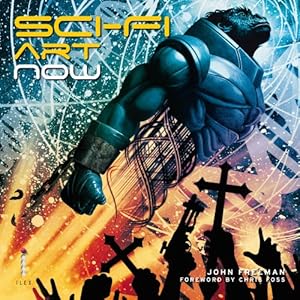
On a related subject, I was recently in contact with Lee Gibbons, the artist who did the cover of Empire of Light, my favourite cover art this far. He happened to mention in passing that the cover design had also been picked to appear in the new edition of Sci Fi Art Now. I hadn't actually heard of the book before, but after browsing through it on Amazon, I think I'll be picking up a copy.

8/26/2010

Reviews, films, and festivals

Let me just self-aggrandize for a moment and tell you about two new reviews, the first being in the September issue of SFX (the one with Star Trek on the cover).

It calls Empire of Light 'gripping, imaginative and morally complex', and also describes it as 'page-turning sf with a distinctive identity and brutal, stylish action sequences, all of which adds up to a compulsive read'. Sci Fi Now magazine, meanwhile, has this to say about the new paperback of Nova War (full review here): 'An immediately enthralling and intelligent read, which captures the reader’s attention through graphic description of numerous exotic species and locations alongside early dramatic developments. Nova War is (...) a shining piece of sci-fi writing'.

Which is a nice thing to find in WH Smiths while you're waiting for a train to Edinburgh, where myself and Emma spent the day yesterday checking out the Festival. We wound up seeing a stand-up comedian called Alex Horne performing a show called 'Odds', partly because he was the first name I saw on the Fringe festival website (one of the advantages of having a name that starts with 'A'), and because someone else recommended him entirely separately. Which just seemed like fate, somehow. The last time I went through to the Festival and paid to see a performance was a long time ago - and I mean a long time ago: a play written by Grant Morrison, of all people.

As for Horne - I'd recommend him. His show isn't really stand-up comedy in the fall-over-laughing sense, although it is tremendously entertaining and remarkably thoughtful. I'm also pretty sure no one else could do a Powerpoint presentation and make it funny. But he managed to tie together gambling, quantum mechanics, and golf into a single hour-long show, which I found very impressive. There are some clips of him on Youtube, but they don't really do his act justice, unfortunately (his website looks a bit more promising).

Apart from that, I'd say the highlight of the day was the ex-Cirque du Soleil performer balancing his entire body, sideways, on one hand, on top of a twenty-foot pole held in place by four slightly tipsy locals pulling on ropes, just off Princes Street.

Films: we recently watched a Taiwanese film called 'Au Revoir, Taipei' (there's a lengthy review at that link), which was a huge hit in Taiwan. It's a romantic comedy about a kid who gets dumped by his girlfriend after she's flown off to Paris, then borrows money from the wrong kind of people in order to fly over and get her back. It's not quite as great as some of the reviews have made out - some of it, I think, is lost in translation - but that's not the only reason to see it. It's practically an hour-and-a-half long advert for Taipei itself, which is no bad thing. We both recognized a lot of locations used in the movie, including quite a few set in the Shida district, where we lived for two years. It's worth seeing.

I am slowly getting in gear for The Thousand Emperors, working on the outline and brainstorming the plot and characters. It's a tenuous sequel to Final Days, which I just handed in to my publisher a few weeks ago. By 'tenuous', I mean you won't have to read Final Days to know what's going on. And after I've finished that, it's on to another Shoal Universe book, which I'm now calling A River Across The Sky.

8/22/2010

The future of sf publishing (not)

I had a read at this article online that explores ways in which an untapped audience of potential sf readers might be persuaded to pick up a new publication with high-production values, modern design and bleeding-edge genre fiction; these would be the kinds of reader who don't identify themselves particularly as 'fans' of sf books, but might be the kind of people who attend, say, Comic Con or go to lots of sf movies or watch Stargate, read Batman comics, etc etc.

There are a considerable number of responses in the comments, enough so that I was forced to skim many of them (I have an outline to write). But a fair number of those I did read tended towards the negative, and a few went so far as to break down the actual costs of publication: paying the writers, the editor, the printing, the time necessary to break even, the percentage of cover price that goes to the distributors, etc, etc. The comments are all worth reading.

Here's my take on this:

1. It's been done. It was called Omni. It was a newsstand magazine first published in the late '70's with stunningly high production values. I loved it, although I stopped buying it in '87 when the quality started slipping. Before that it published some of the most cutting-edge fiction around, including William Gibson's first stories. So, yes, it can be done. But only if you have an sf-loving Bob Guccione sitting on top of a gigantic pile of ready cash made from a long and profitable career in porn.

2. It'll never work nowadays. Key words to this argument: 'Kindle'. 'Ipad'. 'Tor.com' and other online magazines that now publish some very high-quality and award-winning fiction. You don't need to be on a newsstand. Nobody does.

3: Personal anecdote here. Assuming I've read the argument right, there's an enormous untapped audience of people who are sf fans but don't know it yet. They play sf-flavoured computer games, watch sf movies, etc, but don't necessarily read sf.

Well, I have some - admittedly small - experience in small-press publishing. Way back - we're talking early '90's here - I was involved in a small-press publication filled with fiction and articles centered mostly but not entirely around sf. It was, looking back, a fairly decent little magazine. I got to meet some interesting people and interview writers like Kim Stanley Robinson when he'd just started out on the Mars books. Michael Moorcock rated the magazine, apparently, which still gives me a warm and rosy glow of satisfaction. It was a tiny, tiny publication, but a lot of thought was put into it by those involved in its production, not least myself.

I too made the mistake of thinking that 'large, untapped' audience was just desperate for really high quality fiction and articles. When the '95 Glasgow Worldcon was about a year away, the magazine had pretty much finished its run, but I explored the possibility we could put out another, larger glossy-covered publication, possibly a freebie with advertising in it to pay the cost of printing, especially for the Con. The contents I had in mind - both articles and fiction - were influenced to some extent what I was reading in magazines like Boing Boing (yes, it used to be a print publication and I still have copies), the very early Wired and even Mondo 2000, as well as the aforementioned Omni.

I went along to a pre-con meeting of some sort, wanting to talk to organisers there with networking in mind. There were maybe fifty or sixty people there. I spoke to someone I'd been told I should maybe talk to. He nodded seriously as I described what I had in mind, and he told me he knew some people I should talk to.

He introduced me to a gaggle of three or four frankly fucking huge women who also, I was told, had a publication. They showed it to me. It was a bunch of A4 pages stapled together at one corner. The cover showed a bunch of crudely dawn elves wearing Star Trek uniforms on snowmobiles circling a Christmas Tree. I learned their publication had 5,000 subscribers.

My publication had rather less than fifty.

That's the exact point I chucked in small-press publishing, because I realised I was essentially trapped on a tiny island with people who wanted to read interviews with Kim Stanley Robinson and read fiction which was, to my mind, genuinely interesting and thought-provoking (and if you read Interzone over the past ten or fifteen years, believe me, you'd recognise a lot of the names we published). That island, however,  was surrounded by a vast ocean of people posting each other stapled fanzines of elves in Star Trek uniforms. More power to them, I say, if that's what you want. But I didn't, not by a long shot, and I sensed the project I had in mind was not going to find favour with anyone I spoke to in that room. I had a sense I was not being taken seriously. The upside to the story, if any, is that all that experience of producing and editing and designing stuff led to me professionally editing and/or designing a few publications for a tiny Glasgow publisher whose one claim to fame is that one of their telephone salesmen went on to be a well-known Freddie Mercury impersonator. 

Which is my very long-winded way of saying, yes, you can create that publication and aim at that large, untapped audience of would-be fans going to comic cons or watching TV or going to see the new Star Trek movie. But only if it has lots of elves in ST uniforms. Then it'll be a surefire hit.

Did I mention the elves had little red caps on with white bobbles? I shit you not.

8/19/2010

shout-out

Got this through from Mark Harding, who in a sudden fit of insanity felt motivated to send me a copy of Music from Another World, an anthology of new fiction based around, yes, music, edited by his good self. It's identified on the cover as 'strange fiction', but what we're really talking about here, of course, is primarily science fiction and fantasy of one flavour or another. Mark is a member of the Glasgow SF Writer's Circle. There's a good few names I recognize in there, including Aliette de Bodard, Neil Williamson and Jim Steel. Thanks Mark!


You can buy Music from Another World directly from the publisher here.

What the project reminds me of, actually,  is another, similarly-themed project from the '90's called In Dreams, easily one of my favourite anthologies from that entire decade - or even one of my favourites, full stop. You can pick it up for literally pennies off Amazon these days (there's some info about it here). It was edited by Paul McAuley and Kim Newman. If you can track a copy down, you should. 

8/18/2010

Cult of less (vinyl)

I find myself fascinated by one of the recent memes doing the rounds, apparently sparked by a BBC article on the 'cult of less', the idea that you can vastly minimise the amount of stuff you have by selling off, say, your tv, cd's and books and replacing them all with digital media. Those who take it farthest don't apparently need furniture either. Those who take it really far don't need a roof over their head.

Although I wouldn't go that far, I'm sort of fascinated. I've written before about the appeal of reducing the vast load of Stuff I own, although sentimentality and a certain possessiveness prevents me from ever selling the vast majority of my books (I think 'prised only from my cold, dead hands' is apposite here). Even so, it's entirely possible myself and Emma might choose to go back over to Taipei at some point for a good long while. Maybe. We haven't really decided yet. If that does happen, all those books go into a couple of big boxes and stored somewhere, which is kind of a pain in the ass. It's not that easy to be sentimentally attached to something stored in a box in a dark corner somewhere several thousand miles away.

Which brings me to something I might have mentioned before (or maybe haven't), that being the decision to finally sell my old collection of vinyl records, most probably in a single chunk to a local record dealer. I've no idea how much I might get for them - we're talking 500 records at an absolute minimum, possibly closer to 600-650 (all lp's, apart from a couple of twelve-inch singles). Knowing my luck, it would be a laughable pittance.

On the other hand, I no longer value them nearly as much as I do my books. I've converted the vast majority to MP3 format, so it's not like I'm losing the music. Plus, when I thought about it I realised I hadn't actually played any of the physical, vinyl items for getting on, ooh, let's see...fifteen years. In fact apart from the 'dronezone' channel on Soma FM, I've pretty much stopped listening to anything at all. If I'm not writing, I'm browsing the net, or reading, or watching a DVD. Or socialising. And if I really want to check out a piece of music, I can just head to grooveshark.com.

Nonetheless, I've had those records for a long time. There are Hawkwind gatefold sleeves. More than a dozen Black Sabbath albums. The first Jane's Addiction album with the cover that caused record shops to force the band's label to hide it inside a ribbed rubber sleeve. ZZ Top. A crapload of stuff, frankly, all sitting unloved in the cupboard next to my front door. Better, I think, they all wound up with someone who might actually play them from time to time (and remember, I have them all in MP3).

I still have to sort them out into two piles - those I want to sell (95%), and those I won't just yet, at least not until I've resolved the sneaking suspicion they might actually be worth something resembling real money (I'm talking the first Budgie album here).

I may post pictures of the exhumation.

8/04/2010

Well, I'm glad that's over

Writing Final Days, that is. Or when I say it's over, what I mean is: I've finished it to the point where I'm thoroughly sick of it. So it's been emailed off to my agent and editor and at some point, assuming they're happy with what I've produced, I'll get it back, with editorial suggestions scrawled all over it, and I'll have to read the damn thing again. And then there'll be a typesetter's comments (not counting any 'first readers'), and then I'll have to read the damn thing again. Carefully. And then, if all is well, I'll get a copy of the page proofs to read, and, yes, I'll have to read the damn thing. Again. Very carefully. Searching for those niggling little errors.


And I'll still get email pointing out that somebody drives up in a balloon-wheeled truck on page XXX and departs on the following page in the same vehicle, which has miraculously swapped balloon wheels for tractor treads. There will always be mistakes (and please note, if you spot them, I am grateful to hear of them. If nothing else, it keeps me on my toes).