2/27/2011

Plan B

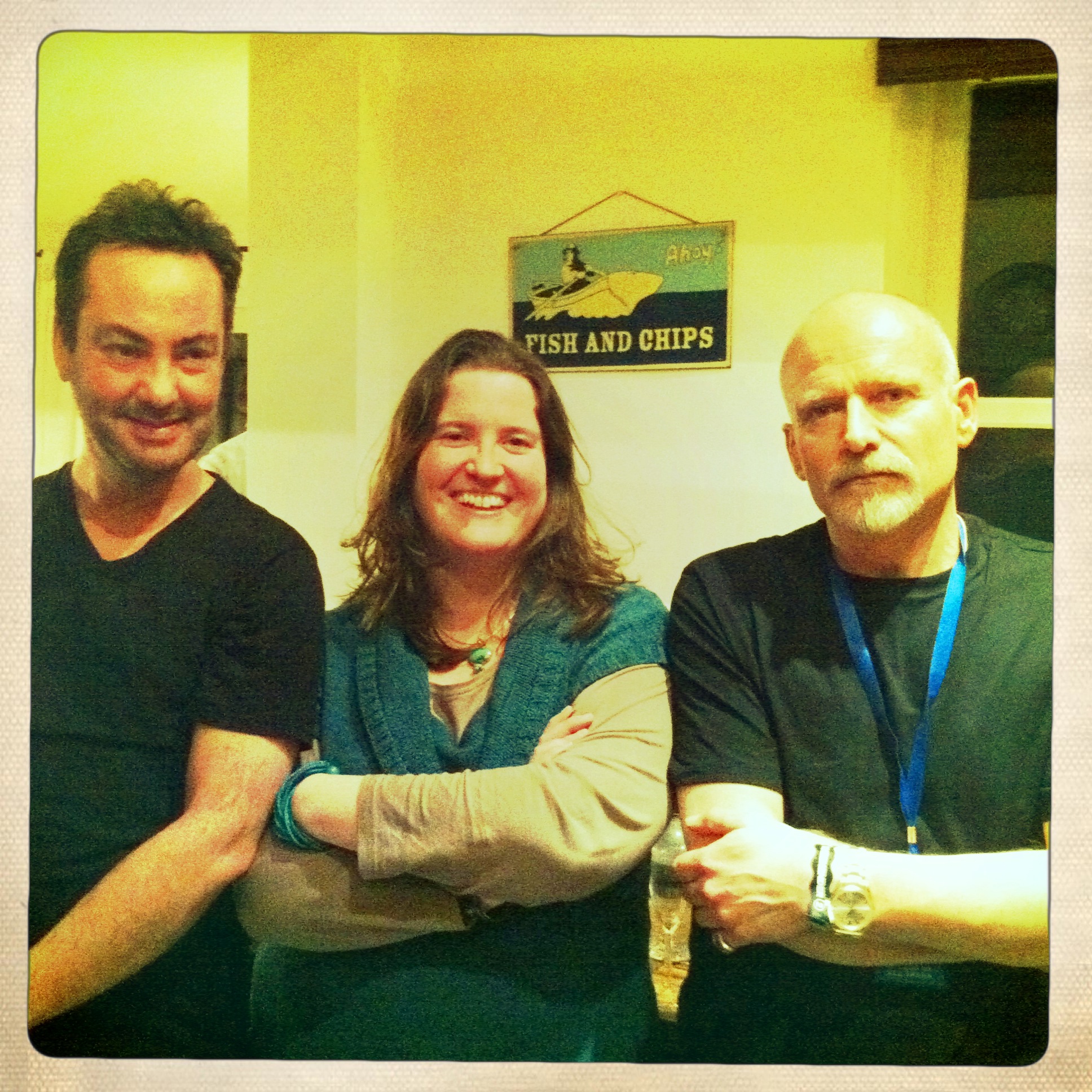
The talk at Plan B books in Glasgow city centre went really quite well, and it was also an opportunity to catch up with Richard Morgan, whom I hadn't spoken to in a couple of years. We had a good, decent-sized audience, and there was a mixture of faces both familiar and new; unfortunately I had to dive out for twenty minutes immediately following the talk,  and it's possible I didn't get the chance to sign books for one or two members of the audience - sorry about that, if that was the case. You'd think it would be hard to fill up a full three hours just talking about writing, but it's surprisingly easy, actually, and between the three of us, with questions from Will Couper, who acted as our host, things rolled along rather nicely.

Here's a picture from the event, courtesy of Mark Harding:


2/24/2011

Teaching SF and Q&A with Hal Duncan and Richard Morgan

Just a heads-up to say I'm going to be teaching a couple of summer evening and afternoon classes, in July and August this year, at Strathclyde University in Glasgow. One is a workshop/writing class, the other is on 'understanding sf', essentially a primer on the field. I don't have the exact dates and so forth just yet, and neither has the cost of the classes been established so far, but I can tell you that each class will run over two consecutive weeks, comprising two classes That means there's going to be a lot packed in to a fairly short space of time, but it's my intention to cram people's heads full of as much incredibly cool stuff as I possibly can. Assuming things go well, this'll hopefully lead on to longer classes in the latter part of the year, running over several weeks.

Remember also that I'll be at Plan 9 Books in Glasgow, on Saturday afternoon, from about 1pm onwards, in conversation with Hal Duncan (Vellum, Ink) and Richard Morgan (Altered Carbon, Thirteen). Plan B, as well as selling books and comics of a distinctly indie bent, also has an excellent little coffee shop built into it, so you'll be assured of being in comfortable surroundings.

2/21/2011

Stupid Idea of the Day 2

I got up earlier than usual today, and my brain isn't really talking to me, so blame it, not me, for what's being written here. I had nothing to do with it. My fingers are protesting at having to type these very words. There. You can't see it, but one of my hands just gave me the finger.

Yeah. Same to you, finger.

Anyway. It must be early, because this is a truly stupid idea, and also a really, really, really old one already far past its sell-by date. It's this: bring back Celebrity Big Brother, but give it a different name, put it on BBC4 and fill it with writers. Martin Amis, Jeanette Winterson, Kazuo Ishiguro, and whoever else you can think of. Lock them in there with access to only one manual typewriter and a limited daily allowance of paper.

Then lightly salt with 'surprise' house guests, particularly book critics. Preferably ones with a habit of writing excoriating reviews. Then get them all to vote each other out not on the basis of how well they get on, but on what they think of what each of them has written that day (limited amounts of paper, say ten sheets each, means they can't spend all day hiding behind the typewriter. Hopefully, anyway). Sort of like a writer's workshop crossed with Rollerball. You could call it Last Author Standing.

Now there's an image that's going to stay with me for a while.

I swear, there'd be blood on the walls. I'd be glued all day. Plus, you'd get something resembling intelligent conversation between people who have enough intelligence to know that Madagascar is a real place, and not just an animated movie.

My fingers would like to inform you this all occurred to me after making a crack about how sharing a cottage with Adrian Tchaikovsky, Paul Cornell, China Mieville, Peter Hamilton and Mark Newton at the SFX Weekender might be compared to a sort of SF/fantasy Celebrity BB house, minus the cameras and bitching. Not that it was really like that, but we spent a lot of time sitting around the kitchen table talking.

2/16/2011

Outcasts

I actually quite like the theme of the series (Outcasts), the idea of whether or not the human race would make the same mistakes, given a chance to start over somewhere else. It's something I've been working towards for a while, even if it's not particularly obvious or evident in my stuff. But in so many respects it's a weird show, perhaps because the writer is clearly far from au fait with either science fiction or indeed science, even the sketchy pop-quiz level of knowledge that most authors get by with. Actually, a better word for it might be 'bizarre'.

It's set in the mid-21st century, barely forty years from now, and we've somehow managed to cross untold light years on board enormous ships that are way beyond blue-sky at the current moment.

There appear to be no vehicles in or around the settlement. They got there by spacecraft, but otherwise appear to walk everywhere. Okay, limited resources, but if they can clone pigs...why not horses?

They have some kind of mobile comms tech that mysteriously operates fine within the settlement's boundaries, but which they mysteriously fail to use once they leave town to look for people who should be eminently traceable using existing and dirt-cheap technology. Of course, half of the story lines would then cease to exist.

There's a kid genius who listens to the Sex Pistols, leading me to the suspicion he's really seventy-five and very youthful-looking for his age.

There's an 'earth mast' for communication with home, as opposed to, say, a cheap satellite. There's a moon or nearby planet so close they look like they're about to hit each other. We've somehow managed to grow fully adult human clones with special genetic abilities and ship them to another planet and get reports back from there, sometime in the next 40 years, so far as I can judge, at rather less than light speed. 

A lot of things can be put down to budgetary restrictions, no doubt. There are many things that could, with just a tiny bit of effort, be easily explained away.

I could get annoyed, but I'm too weary. Fish, barrel, shotgun. You know the drill. I can actually picture the manuscript report I could put together for the guy behind this series, and the list of recommended reading regarding plausible back-grounding I'd give him. Nothing technical, just a couple of book titles, non-fiction plus a smattering of novels by people who actually manage to write this stuff in a believable way. Then I'd explain why these mistakes would kill any chance of his getting his novel published because he'd be laughed out of print. Then I remember he's not a novelist but a script writer;  a new writer on a prime time BBC drama can pull down, at minimum, something like thirty grand per hour-long episode. That's a couple of hundred k for writing something pretty much any print publisher or agent in the land would bounce right back out the door for lack of plausibility, insufficient world building and confusing story structure.And yet there it is, on our television screens.

There is, I remind myself, no point in getting annoyed.

2/10/2011

Why China (might) never rule the world

Troy Parfitt is a Canadian writer I first got to know in Taipei through my wife; they taught at the same school for several years. I've read and enjoyed Troy's previous book, Notes from the Other China, although I understand that some of his observations in that book caused some minor controversy. His follow-up, Why China Will Never Rule The World, is coming out later this year, and in it he's going to attempt to present a thesis on why he doesn't think China is going to present nearly the economic threat to the West - or indeed the rest of the world - that many seem to believe. Given that I spent a couple of years in considerable proximity to China (although the closest I got to actually visiting the place consisted of nothing more than a couple of trips to Hong Kong), I find the whole debate quite fascinating.

Troy's put together a promotional video where he talks about the thinking behind the book. You might have to use the password 'china' to access it.

China from Tyler Ellis on Vimeo.


There's an excerpt from the book here. Another book worth reading on the subject of China is The Man Who Loved China, by Simon Winchester, a biography of Joseph Needham.

2/08/2011

SFX Weekender

Well, that was a blast. I just spent the weekend being a guest at this year's SFX Weekender at Camber Sands, not far from Brighton. I'll be honest - the location struck me as being a bit bleak and remote, although that was as much a function of the time of year and the howling winds sweeping along the beaches nearby as much as anything else.

There were a lot of people there, and it's easily one of the biggest cons I've ever been at, barring a couple of Worldcons. I understand there were between two and three thousand people there over two days, but if you told me there were more, it wouldn't surprise me.

Via Mark Newton's blog: giant robot terrorizes audience.
The moment I'll most remember? The rabbit-in-the-headlights experience of finding myself on a huge stage in front of several hundred people, and quite possibly more, hearing my voice boom out across this vast freaking hall, just an hour or two after Chloe from Tor had picked me up from the train station at Rye. I was taking part in a panel on 'science in science fiction' and, as interesting as it was, it was also just a tiny bit overwhelming. I turned to my right - I was bang in the middle of the line-up behind a long desk - and saw Stephen Baxter and Peter Hamilton. To my left, China Mieville, Paul Cornell and Kevin J. Anderson. All speaking with an air of confidence and erudition that was, for want of a better word, challenging.

Dear god. Rabbit in the headlights for sure. The sound wasn't as good as it could be and for much of the hour I was up there, the audience was in fact mostly invisible due to extremely powerful lights shining onto the stage. It reminded me of a conversation I'd had with a friend who performed in various metal bands way back in the Eighties; I'd asked him if he ever got nervous up on stage, and he replied that most of the time you couldn't even see the audience, so that took a lot of pressure off. He was right.

The sound problems - including a heavy echo across this vast, hangar-sized room - meant I had to keep leaning over to hear what people next to me were saying. Every time I turned towards China on my left, I kept getting distracted by the highly detailed tentacle tats wrapped around his arm. The rest of them had an admirable rapport with the audience, indicating they had considerably more con panel experience than I've yet managed to muster even in several years as a writer.

Given the circumstances, I made a point of not saying anything unless I could make it as clear and cogent and pointed as possible. Unfortunately, by the time I felt like I was starting to relax, the panel was just about over. And that was my only panel, apart from a signing session in the company of all the other Tor writers the next afternoon, which went about as well as I'd expected.

Me, Orbit's Anne & JC Grimwood, via the Orbit blog
Some observations about the con itself: I didn't actually see a great deal of it, since the majority of the time, myself and the other Tor writers were at a cottage our editor Julie Crisp had hired just down the road from the holiday camp. Tor UK threw a party on the Friday night, where most of the Orbit crew turned up, and a lot of other people. It got pretty crowded, and proved to be a good night. I had excellent company over the weekend - my editor Julie Crisp, Chloe and Amy, also China Mieville, Mark C Newton, Paul Cornell (with whom I shared a room), Adrian Tchaikovsky and, of course, the iridescently-waist-coated Peter Hamilton.

Here's one thing that did particularly strike me about SFXW: it reminded me so much of the conventions I first went to, back in the early/mid Eighties. My first ever con was in Glasgow, maybe in 1982 - an Albacon, I think - and I've gone to them more or less regularly ever since. Contrast that with a lot of pro writers at SFXW for whom this was apparently only their first, second or third convention.

Back in those days, you had all kinds of fandom present. There were people like myself who were primarily into fiction, but there were also Star Trek fans, Star Wars fans, comic fans, and every other kind of fan; movies, media, and books, all mixed in together. Over the next several years many of these groups evolved their own media-related cons and the attendance at specifically sf cons such as Eastercon grew more specific and also smaller. This led into what's been described as the 'greying' of fandom, as younger fans fail to attend.

SFXW wasn't like that at all. Those attending were split roughly equally half and half in terms of males and females, and the majority were also refreshingly youthful. There were even quite a few families. These are people who I suspect certainly read plenty of sf but love their movies, comics and tv shows just as much. On top of that, the organisers put on a terrific show the likes of which I have never experienced at any con. There was a sense of fun I haven't felt since I was a teenager attending my very first cons.

That's not to say I don't have one or two criticisms, though they are relatively minor ones. The SFX awards ceremony started off with dancing girls in bikinis. All I'm saying is, this is the 21st Century, folks, and for me science fiction is supposed to be about looking forward to an era of equality and balance. Instead I felt like I'd fallen into some sf-oriented version of a night club straight out of Mad Men. There was, at times, a level of objectification of women that made me just a tiny little bit uncomfortable. Or possibly more than a tiny bit. If you're going to have dancing girls, you might as well balance it out and have male dancers of a similar style as well, otherwise there's the risk of engaging in some pretty blatant stereotyping not only of the women concerned, but ultimately of the fans too. I know the portrayal of women in this way isn't a phenomenon limited to certain aspects of the sf genre - I've been to computer trade shows in Taiwan and, believe me, they're probably worse in this respect - not to mention endless newspaper shots of some new sports car with a half-naked model draped across it - but that doesn't necessarily make it right.

Also, I think I mentioned the location - a Pontin's holiday camp, in early February, for God's sake - was kind of bleak. Also, to put it mildly, out of the way. I had to fly down to London the previous night, stay in a hotel, get up at the crack of dawn, take a train to Brighton, then switch to another train to Rye that took waaaay longer than I thought it would, then get a lift from Rye to the camp three miles away. I can imagine the logistics of putting on an event like this are fairly horrendous, however, and with any luck the event will take off well enough in the future that SFX might be able to find a more central or urban location. It's a tribute to them that they managed to pull things off quite so well as they did given the circumstances.

If there's one advantage institutions like Eastercon still have, it's that they largely take place in hotels, which provide endless opportunities for socialising and meeting new people either in corridors, bars or at the many, many room parties. SFXW, on the other hand, took place in a large echoing hall (plus a tiny pub next door), physically separated from the rather barracks-like buildings surrounding it. Getting from one to the other meant fighting your way through a bitter, howling gale coming straight off the sea. Nonetheless, I think there's a very, very, very great deal trad cons could learn from an event like SFXW, and I came away thinking cons like this are going to lead the way in the coming years. It was enormously fun, and I'd do it again in a flat second.

1/27/2011

Incoming, appearances, etc

Coming up: next week I'm one of several Tor writers taking part in the SFX Weekender down near Brighton way; it'll be my first full-on media type con (excepting Sci-Fi London last year, which I was only at for the day). Apart from myself, there'll be the likes of Peter F. Hamilton, China Mieville and others.

Later in the month on Saturday February 26th*,  I'll be at the excellent Plan B Books in Glasgow (5 Osborne Street, just across from 13th Note) for a live chat and Q&A along with Hal Duncan and Richard Morgan. See you there!

*Yes, I know the Plan B site says 19th February, but to my knowledge the date has been switched to the 26th.

1/19/2011

My Stupid Idea of the Day

It occurs to me I have lots and lots of ideas for things, not just stories, but most of them really, really stupid. Black-and-white-footage-of-some-bloke-smoking-a-pipe-and-cycling-off-the-end-of-a-pier-on-a-bicycle-equipped-with-hilariously-flapping-wings-stupid. Then I realised I had a blog, where I could post all my stupid ideas if I wanted! Brilliant! Maybe I'll make it a regular feature (or more likely get bored with it and never write another 'stupid idea of the day' post).

My stupid idea of the day ('stupid' because there's probably a plethora of rights-related issues that would make it impossible): can't finish a story? Upload it to a website filled with other, unfinished stories, then browse everyone else's still-borns and see if you can think of a really cool ending for them. The website - let's call it 'finishmystory.com' - would have tiers of membership, including a restricted-access area especially for writers with a proven professional track record of publication. Because even pro writers have lots of stories they never finish, because they can't think of an ending!


Let's say you upload your unfinished story to the site. Somebody trips along, checks out the one-paragraph summary, maybe even recognizes your name, then suddenly sees how to finish the story. It's got them all fired up. So they contact you, you agree to collaborate (if you like their idea), they write the ending, and if the story sells, you split the payment. Simple!

Except, of course, it isn't. The legal ramifications are probably horrifying and complicated. Where I could see it maybe working is in the context of an invitation-only forum you can't join unless you're specifically invited, run by and for pro authors with unfinished short stories languishing on their hard drives.

But, it's an idea, just one in an endless list of stupid ideas I have all the time. And -- hey! There's another really stupid idea! A website where people can post up all the really stupid ideas they've had. We could call it...

1/05/2011

What I want most in the New Year is...

...a magic button on the back of my neck that, when flicked, makes me suddenly enormously enthusiastic about writing in the morning. Because it would solve a lot of problems, really it would.

I have always been at my best, writing-wise, in the late evening, and very early morning - between midnight and two a.m. But the way my life is arranged these days, my life would be an awful lot easier, vastly more productive and leave me more time to get various things done if I wrote in the morning instead; between, say, eight in the morning and midday.

But I just can't do it. I've tried, but only managed it on rare occasions. The fact is that no matter how awake I am in the morning, I just can't contemplate writing fiction until much later. My brain refuses in most cases to do it. Even if I get up early after a really good night's sleep, some part of my brain remains completely futzed until at least two or three in the afternoon. The creative side of me just won't become fully functional until after sundown.

There are night people and morning people, and I most definitely am not a morning person; nor have I ever been. I've done a little online research to find ways to boost my morning productivity, but it doesn't look hopeful. You can tell me all about changing habits, getting to bed earlier, etc, but it doesn't work. Before two in the afternoon at the very earliest, I stare at the manuscript I'm working on and it's like all the lights in my head are off. There's no enthusiasm. Even after two in the afternoon and before (say) eight in the evening, forcing myself to write, as I usually have to, turns into an awful, grinding process, like trying to start a half-frozen car in the depths of winter with all its windows iced up.

And yet many other writers do manage it. I really wish I knew how they do it. If there are any miracle cures, I'd love to hear about them.

12/23/2010

A Modest Proposal (regarding ebooks)

I would like to make 'a modest proposal' concerning the ebook market, given that I agree fully that authors should get paid for their work. I should know, I'm one of them, and yet according to some we are about to be inundated by a vast wave of piracy that will see artists and creators of all types rendered destitute.

Now I must confess some of my sins.

I am forced to admit that at least one third of the paper books on my shelves are - according to the definitions employed by those concerned that the wide availability of ebooks will lead to the collapse of the industry through piracy - pirated. To be precise, a substantial number of them were acquired from shops that pay a few pence for used copies and then sell them for profit to people too lazy, corrupt or poor to either want or be prepared to buy them from Waterstones. These dens of illicit literary corruption - from which not one penny is returned to authors - are known in the trade as 'second hand bookshops' or occasionally as 'charity shops'. If you agree that authors should always be paid for their work, I'll help you paint the protest signs and we can start picketing the local Oxfam shops, who are clearly Pirates in Disguise.

I have also read books for which I didn't pay anything. This is part of a nefarious back-street system called 'loaning'. I know! It sounds so innocuous, and worse, there are people who 'loan' these books to children, the despicable fiends, deliberately getting them hooked on stories. And does the author get a penny from this back-hand trade? Not one. Does it matter if they then go on to become dedicated readers who fill their homes with books that profit my career and that of others? Of course not, and I have now learned the error of my foolish ways. Fortunately, most ebooks are virtually impossible to loan, nipping this one in the bud.

This system has become so institutionalised that it is now state-supported in dens of thievery called 'libraries'. In the UK and a few other countries, they actually give you a few pence per loan of a book, and I mean just a few pence. Clearly this is a sop to modern morality. But in other countries, such as the US, the author gets nothing. Diddly squat. Us authors are forced to sit around while complete strangers wander in and out of these 'libraries', reading our books. For free!

Of course, as we all know, this library/second-hand/loaning system brought the publishing trade crashing to its knees decades ago. Why, it's just the other day I was out on the streets next to Charlie Stross and Hal Duncan, begging for loose change, and discussing how this terrible state of affairs came about. Some people actually tried to suggest to us that, having read books for free in libraries or from getting them from friends, that people might actually then go and buy the rest of our work for the full price from regular bookshops! Clearly this is nonsense, since as we all know that once someone knows they can get one for free, then they can get them all for free, so why bother ever paying anything at all when the local Oxfam or library is often just a few blocks away for most of us? And even if they're willing to pay a few measly quid in a second-hand shop for one of our books, do we get anything back from that? No!

And to think some people point to Baen.com, which gives away enormous quantities of ebooks for free and without DRM, yet still claims to make a profit by massive sales of just-published books by those same authors whose previous works they have given away. Clearly they must be mad, insane or lying.

But I stand erect in my new-found moral fortitude. I will cease 'loaning' books to kids that I think might like those works, and accept that, having learned to get things for free, they will never go on to buy their own in the way that I did. I will also cease loaning to friends and stiffly inform them, should they enquire after a particular volume on my shelves, that they would be stealing from that author if they did not go out henceforth and buy their own copy. Fortunately, anti-piracy restrictions on my own purchased ebooks make it completely impossible for me to loan ebooks to friends in this way. Thank goodness Amazon had the same moral fortitude and saved me from myself!

As for DRM, well, clearly it's for our own good. Just because we legally purchased a book doesn't mean we can be trusted with it, after all. And if you can't trust the people who actually spend their money on ebooks, well, who can you trust? No one, obviously! Therefore it's only right that, unlike those who pirate, we should be forced to struggle to get our books to run on our chosen ereaders, or suffer the risk that future legal, political or social changes might result in those same purchases being deleted from our machines (http://nyti.ms/i8jinH). Sure, that regionally restricted ebook is easily available anywhere in the world, frequently postage-free, dirt cheap, second hand or new in its paper form (abebooks.com, bookdepository.com), but that's not the point, is it? Who ever said reading ebooks should be easy?

Amazon and all the rest are therefore quite right to make it extremely difficult for me to read my books on anything but my Kindle, and only those ebooks 'available' in the UK (but still completely available as paper books, entirely regardless of their point of origin). And if it breaks, or Amazon go out of business, or if for any reason decide I shouldn't be able to read my ebooks anymore, then it's my own damn fault for engaging in this silly ebook business. And if I want to get another machine that turns out not to be able to read the hundreds of ebooks I've already bought, well, if I can shell out for an ebook reader, surely I can afford to throw away all those locked and drm-ed ebooks I've spent hundreds of pounds on and buy them all over again on the new device. Which will also be regionally restricted and locked with DRM to that device. Of course, regional restrictions on ebooks are necessary, even though - as I pointed out - we can easily purchase those exact same books. in paper, from just about anywhere in the world, and in vastly greater quantities than ebooks are currently selling.

 Now, I could break the encryption on those ebooks in approximately five seconds using drag and drop freeware that requires zero programming skills but, stiff upper lip and moral rectitude, as they say. Yes: I will embrace an experience of the new age of ebooks far, far inferior to that of those who still prefer to read paper books because it's the moral, legal thing to do.

But it may be too late! Even our legal systems are crumbling in the face of this anarchy. A foolish judge in the US court system has gone so far as to say that illegal downloads cannot be equated to lost purchases! The only way we can correct this terrible imbalance is by making the ebooks at least as or more expensive than their paper equivalent to rake back all those lost sales from downloading, loaning and buying second-hand and ignore those poor deluded fools who claim to have rushed out to buy copies of books by an author one of whose works they just read for free as an ebook. 

Clearly the world has gone mad. To the barricades!

Some references that may be of interest to those reading this blog: The Problem is Legal Scarcity not Illegal Greed, Cory Doctorow on why you should download his books, Author condemns piracy, outed as pirate, Charlie Stross on Ebooks, Ebooks: Neither E Nor Books.

12/16/2010

That was the Decade that Was

I can't say the 2000's have been too bad for me, characterised as they have been by my becoming a professional and eventually - at least, at the moment - full-time novelist. I started this blog just a few months before I finally got a sniff at a book deal, and an actual deal another few months after that. I'd written my first (practice) novel in 1997 while signing on and waiting for a college course to start, and that led me to selling the second novel I ever wrote, Angel Stations in 2003 (published in 2004). I put the upfront payment from Tor into a deposit and got my first flat, finally moving out of the hideous dump I'd shared for several years with another writer (who himself had already moved out when he scored his own first deal). Apart from a brief break abroad, I've lived in that purchased flat ever since.

I finished Against Gravity, my second book, and saw that come out in 2005. My third, Stealing Light, didn't appear until 2007, but when it did, it came out in hardback and sold - and still sells - exceedingly well. Sequels seemed to be the way to go, so Nova War came along in 2009, and Empire of Light in 2010.

I started writing Nova War in Glasgow but finished it in Taipei, having them met Emma, my then-girlfriend and now-wife, when she was studying in Edinburgh.  Empire of Light was written in its entirety in Taiwan. I started Final Days there, but finished it back here in Glasgow, a few months after we returned earlier this year. And now that's done and dusted, and I'm a quarter of the way through its sort-of-sequel. The Thousand Emperors. I even had a short film of a script made by the BBC just prior to my departure to the Far East.

I rather hope that this is a trend that will continue over the next decade. There are certainly more things I'd like to achieve; writing a comic or graphic novel is definitely in there as a possible goal, although right now the thing that would make me really happy is a US deal for my books. But, still. All in all, a pretty decent ten years.

12/02/2010

Kindle

I finally bought a Kindle to replace my Sony Reader. The Reader is a wonderful device in many ways, but getting ebooks onto it can be a pain in the arse. The Kindle is different. There are still hurdles that have to be dealt with, of course - getting rid of DRM, in particular - but as a reading experience it is,without a doubt, superior. The screen is a little clearer and sharper and less reflective than the Sony. I got the basic WiFi model, since the 3G version is aimed mainly at people who travel a great deal more than I do or people who struggle to get a file from their computer and onto an external. Although I can browse the Amazon website from the Kindle itself (as long as I'm range of a WiFi transmitter), it's generally a lot easier to do it from my own Macbook and just have Amazon send samples of books I'm interested in to it direct. I particularly like the onboard dictionary, and the Kindle's case feels more tactile as well (the Sony always felt like it would slide out of my hand at any second).

And, frankly, books just look better on the Kindle than the Sony, by a long way. Emma's going to inherit the Sony for something to read as she travels to work.

As I already said, getting hold of it proved to be something of a hassle. The first time I ordered one, Royal Mail and Amazon's website told me it had been delivered to me. That ended with me calling Amazon who filed it as stolen and refunding the money. I wound up ordering another one from Amazon, but on special delivery, and guaranteed to arrive by 1pm the next day.

Guess what: it didn't turn up the next day. I called Amazon and got them to refund the cost of the special delivery. It did finally turn up, yesterday morning, the day after it was supposed to arrive. Now I've got two in the house, one of which is waiting to be picked up by DHL and returned to Amazon.

Interestingly enough, after having made enquiries at the one store in town that sells the Kindle over the counter, and being informed it's selling so fast they can't keep it in stock, I suspect the predictions that the Kindle is this year's hot ticket for Christmas Day might be on the money.