So it's late October, and outside it's ... sunny and warm. (Adopts craggy stare of doom-saying Scotsman) ... it's the end times, I tell ye, it's no' natural: the seas are gonnae rise up and potatoes'll be worth more than gold dust, aye, we're doomed, DOOMED I tell ye, Doomed ...
I just came out of a minor attack of flu, and not a pigeon in sight. Felt well enough a couple of nights ago to make it along to the Halloween-ish meeting of Edinburgh's Writer's Bloc at the Canon's Gate pub with Mike G and Phil Raines from GSFWC, at which surely the highlight was Gavin Inglis' 'Springheeled Jock', the delivery of which should surely be the measure of all pub spoken word events. Gavin, I salute you. And your comedy fake beard, wherever it may roam.
The past couple of months have actually been surprisingly busy in a fun way, which is one reason for (insert typical excuse here) my pathetic lack of blogging. What can I say? Sorry, I have a life, okay? Like Al says over at geek show, Duncan Lunan had a sixtieth at the Bon Accord several days ago: I don't know what deal the bastard's made with Auld Nick, but the fact he looks twenty years younger than he actually is ... well, it's no' natural, I tell ye ...
Writing: the ten minute script I submitted to the BBC's Tartan Shorts has currently made it as far as the longlist, but of course that's no guarantee it'll get any further. If it doesn't, it's going to my agent, who works with another agent to er, agent scripts for tv and film. People have said I'm getting my hopes up too high concerning scriptwriting, but the point isn't about getting your hopes up, it's about giving it a shot regardless of the hopeless bleedin' odds against it. You could make exactly the same series of statements about writing novels, and I got a couple of those published, so what the hell.
There's going to be another joint Writer's Bloc thing in mid-December, and I'll be back along to that: it's likely several of us from GSFWC will also be participating, so come along and say hello if you're in the area. I keep meaning to write something for it, but I'm hardly the best organised for this kind of thing - plus, I tend to set myself high standards: it's got to not only be a good story, it's got to be in a suitable style for reading aloud. Think more 'stand=up' than 'intricate prose'.

10/31/2005

10/06/2005
Wednesday last: disaster. I'm sitting at my usual place - laptop on coffee table, in kitchen - when the phone rings. So I stand up, reach for the phone, and my foot catches the power cord. Too late: the laptop slides off the edge of the coffee table, and hits the floor, edge first. The whole thing in slo-mo in my head.
Well, at first it looked like it was fine, but it turned out the usb ports were gubbed: I'd had a usb modem plugged into it when I stood up, and that clearly twisted and broke the internal usb slots. Oh joyous fucking day. And thank my lucky stars I hadn't stuffed my desktop pc away in a cupboard somewhere, like I'd been intending.
Thing is, since Wednesday, I've only been able to get on the net on my old desktop. And (aside from the mental shutdown mentioned in the next paragraph) I'm getting more writing done. Big surprise, really: it's way too easy to keep checking the email, look stuff up on Amazon, on the laptop. Now the work is evenly split between two machines: ancient pc for email and web, laptop for writing. One day I'll get a wifi card so I can not get around to ever sitting in coffee shops pretending it's actually possible to get work done surrounded by dozens of people talking loudly.
I crashed last weekend, and hardly did any writing, something I'm hoping to fix this weekend. Mind you, some good news: word from the agent is Against Gravity's been picked up by a Spanish publishing company for release in November 2006.
I think I mentioned before I'd put a short (ten minute) script into something called Tartan Shorts, where the BBC pick three scripts for production. The benefit isn't just to new writers, it's to producers, engineers, directors, whatever. I made the longlist out of maybe three hundred entries, which was apparently enough for me to get invited along to the BBC to talk to two producer types about how I saw the film being made, should it get so far as the top three: I had no idea what I was supposed to say, being entirely new to this kind of thing.
The story is set in an isolated religious community in the Highlands in the near future. It's very much science fiction.
At one point, one of the women said, 'you know, with the technology and the robots, it could almost be ...' She mused for a moment, before leaning forward. 'Almost sci fi.'
But it is science fic - I started to say, then closed my mouth and sat back, remembering the monthly lists of actors in Ansible saying their new movie featuring faster than light ships and aliens wasn't really science fiction, it was ... futuristic drama. I give up. I have no fucking idea what goes through these people's heads. No, I do know, but it's too depressing: what goes through their heads is Buck Rogers and flying cars and, I guess, a big blank nothing when it comes to imagining the world even a year or two from now.
So anyway, they're looking for a rewrite, for two weeks from now. What they're looking for seems faily reasonable, so that's something else to muck about with. I need a holiday.
Well, at first it looked like it was fine, but it turned out the usb ports were gubbed: I'd had a usb modem plugged into it when I stood up, and that clearly twisted and broke the internal usb slots. Oh joyous fucking day. And thank my lucky stars I hadn't stuffed my desktop pc away in a cupboard somewhere, like I'd been intending.
Thing is, since Wednesday, I've only been able to get on the net on my old desktop. And (aside from the mental shutdown mentioned in the next paragraph) I'm getting more writing done. Big surprise, really: it's way too easy to keep checking the email, look stuff up on Amazon, on the laptop. Now the work is evenly split between two machines: ancient pc for email and web, laptop for writing. One day I'll get a wifi card so I can not get around to ever sitting in coffee shops pretending it's actually possible to get work done surrounded by dozens of people talking loudly.
I crashed last weekend, and hardly did any writing, something I'm hoping to fix this weekend. Mind you, some good news: word from the agent is Against Gravity's been picked up by a Spanish publishing company for release in November 2006.
I think I mentioned before I'd put a short (ten minute) script into something called Tartan Shorts, where the BBC pick three scripts for production. The benefit isn't just to new writers, it's to producers, engineers, directors, whatever. I made the longlist out of maybe three hundred entries, which was apparently enough for me to get invited along to the BBC to talk to two producer types about how I saw the film being made, should it get so far as the top three: I had no idea what I was supposed to say, being entirely new to this kind of thing.
The story is set in an isolated religious community in the Highlands in the near future. It's very much science fiction.
At one point, one of the women said, 'you know, with the technology and the robots, it could almost be ...' She mused for a moment, before leaning forward. 'Almost sci fi.'
But it is science fic - I started to say, then closed my mouth and sat back, remembering the monthly lists of actors in Ansible saying their new movie featuring faster than light ships and aliens wasn't really science fiction, it was ... futuristic drama. I give up. I have no fucking idea what goes through these people's heads. No, I do know, but it's too depressing: what goes through their heads is Buck Rogers and flying cars and, I guess, a big blank nothing when it comes to imagining the world even a year or two from now.
So anyway, they're looking for a rewrite, for two weeks from now. What they're looking for seems faily reasonable, so that's something else to muck about with. I need a holiday.
10/03/2005
I like this. Apparently there's a thing going around where people put up the first lines or paragraphs on anything they're either working on, or that's unfinished, unpublished or whatever. It came via Charlie Stross' blog, I think. So here's my contributions:
Funnily enough, Stross isn't the only writer I've found who seems to keep two blogs - one regular one, one on LiveJournal. I'm not sure why. Just one is a bad enough excuse for excessive procrastination.
THE FRACTURE (unfinished novel)
Jacob gripped the shunt unit in his hand and glanced up, seeing a baneful Chicago moon hanging low over the alley. The unit pulsed red against his skin. He closed his eyes, and when he opened them, bright afternoon sunshine spilled across crumbling stonework and mossy flagstones. He put a hand up to shield his eyes from the sudden light and turned in the direction of the stables.
WESTERN GOTHIC (unfinished wild west horror fantasy)
Rain slashed down on the south-east coast of China, turning the sky into a slate-grey wall that extended from the top of heaven down to the waves that crashed against the pebbly beach. Lawton pulled the hood of his cape tight around his neck, rivulets of rainwater somehow still finding their way inside. He felt cold, damp and miserable; under the cloak, his wet cotton shirt stuck to his skin. He cleared his throat and tasted salt.
CONVERGENT
There were memories here.
If it had a name, it would be Teacher. Humans called its kind Baskers. It lifted its pale-furred snout and scented the remembrance of other times, carried to the rocky ridge on which it stood by warm, sulphurous winds blowing up from the lake below. The Basker tasted memories and snatches of thought, pissed or spat onto rocks and the wide roots of the canopy trees that towered over the landscape.
A GIFT FROM THE ANGELS
Lian stood on the roof of the only world she had known until the age of thirteen, and felt the wind lash at her face like a frozen whip.
WONDERLAND/THE SIGHT OF THINGS UNSEEN
Jonah woke suddenly to darkness, wondering just what it was he'd heard.
The back of his head rested against the scarred and beaten leather of the couch he fell asleep on most nights, usually to the serenade of police cars wailing their way downtown. The sound of the sirens always made him think of listening to Charlie Parker, forlorn yet also hopeful at the same time. He stared up at the cracks that patterned the ceiling, like the relief map for some river valley hidden for centuries from the sight of man. The plaster was now streaked with pale moonlight that drifted through tall windows overlooking a fire escape. Jonah shivered, the gas fire to one side of the window cold and inert as an empty promise. Here and there, beyond the narrow pool of illumination cast by the single bulb hanging above the coffee table, could be seen several tall canvases, all shrouded in white sheets.
STEALING LIGHT
Sonja looked up, and saw stars.
Her breath frosted in the cold night air, puffing out from behind the scarf wrapped tight around her neck and chin as a chill winter wind whipped across the darkened courtyard. Dark blonde hair spilled out from under a knitted cap pressed down over her head. Tutor Langley stood next to her, the craggy features of his face rising above the upturned collar of his heavy black coat like an island of basalt above a wine-dark sea.
Funnily enough, Stross isn't the only writer I've found who seems to keep two blogs - one regular one, one on LiveJournal. I'm not sure why. Just one is a bad enough excuse for excessive procrastination.
9/28/2005
I got an okayish review in SFX for Against Gravity, where it got three stars out of five: weirdly enough, that's half a star more than they give Charlie Stross for Accelerando on the opposite page, and he just won a Hugo! An object lesson, as if it were needed, in why reviews should never be taken too seriously.
At one point, the book is described as 'a film pitch in search of a green light', which I found kind of amusing, since making a movie out of it was about as far from my mind as it could get.
By the way, if you want to leave a comment in future, I've had to switch on word verification after getting deluged by comment spam.
At one point, the book is described as 'a film pitch in search of a green light', which I found kind of amusing, since making a movie out of it was about as far from my mind as it could get.
By the way, if you want to leave a comment in future, I've had to switch on word verification after getting deluged by comment spam.
I read on Boing Boing about a new, open source portable games machine, movie viewer, mp3 player, and text reader in one: want one, particularly since it's going for just over a hundred quid. Unfortunately, it's going to have to wait. Possibly, for a long time.
Then I tripped over a new blog by the editor of Spike Magazine (via Mumpsimus) which lists new, free books on the net. Want one even more, so I can read them on it. But what I really, really want is one of those Japanese ebook machines (Librie? Librio? Whatever) that turned up on The Gadget Show earlier this year, which, according to the presenter, did pretty much reproduce the effect of reading text off the printed page.
No, paper books are a long way from being replaced. I agree. But it does occur to me that when we can extensively read even from popular newspapers on our computer screens, it's really a short jump from there to reading ebooks on the subway or bus, especially when (or if) a lot more textbooks, say, end up being published electronically. Imagine if you never had to lug those heavy great tomes around uni. Students of the world unite, you have only your etexts to gain.
Then I tripped over a new blog by the editor of Spike Magazine (via Mumpsimus) which lists new, free books on the net. Want one even more, so I can read them on it. But what I really, really want is one of those Japanese ebook machines (Librie? Librio? Whatever) that turned up on The Gadget Show earlier this year, which, according to the presenter, did pretty much reproduce the effect of reading text off the printed page.
No, paper books are a long way from being replaced. I agree. But it does occur to me that when we can extensively read even from popular newspapers on our computer screens, it's really a short jump from there to reading ebooks on the subway or bus, especially when (or if) a lot more textbooks, say, end up being published electronically. Imagine if you never had to lug those heavy great tomes around uni. Students of the world unite, you have only your etexts to gain.
So I've been busy, writing different outlines for Tor and waiting to see which, if any of them, fit the bill for whatever it is they're looking for. More discussions led to more frantic scribbling, and after two weeks of solid hardcore creative action a fresh outline (eight thousand words, hey, they said they wanted detailed) went sailing through the ether Friday last. So, back to waiting and wondering.
I made the horrible mistake of pulling some childhood favourites from the shelf in a fit of nostalgia, partly driven by a conversation in the pub with Hal Duncan in which he mentioned re-reading a lot of Alfred Bester lately. So I dug out 'Star Light, Star Bright' and re-read the first two stories, Adam and no Eve, and Time is the Traitor. Horrible mistake. Horrible, horrible mistake. Book goes back on shelf. Have I learned my lesson? Do I turn away from the execrable fiction of yore? Do I hell. Next down is The Best of AE Van Vogt, with one of those Seventies paperback covers that screams second hand bookshop at you. Got halfway through 'Weapon Shop' before doing everything but bouncing it into the wastebasket. Sod nostalgia. I reached for my copy of Shepard's 'The Jaguar Hunter' and got on a lot better with that.
I made the horrible mistake of pulling some childhood favourites from the shelf in a fit of nostalgia, partly driven by a conversation in the pub with Hal Duncan in which he mentioned re-reading a lot of Alfred Bester lately. So I dug out 'Star Light, Star Bright' and re-read the first two stories, Adam and no Eve, and Time is the Traitor. Horrible mistake. Horrible, horrible mistake. Book goes back on shelf. Have I learned my lesson? Do I turn away from the execrable fiction of yore? Do I hell. Next down is The Best of AE Van Vogt, with one of those Seventies paperback covers that screams second hand bookshop at you. Got halfway through 'Weapon Shop' before doing everything but bouncing it into the wastebasket. Sod nostalgia. I reached for my copy of Shepard's 'The Jaguar Hunter' and got on a lot better with that.
9/17/2005
The weird thing is, I started this blog so I could, you know, talk about writing. What's weird about that is, the farther you get into the whole professional side of things - the business of writing, as it were - the less you feel free to talk about it: the important stuff, the stuff that's occupying many of your thoughts, is between you and your editor and your agent. So I find myself in a curious position I suspect a lot of writers do, where you gradually sort of self-censor yourself because to do otherwise would be to divulge what are, really, confidentialities. Which is a shame, because there's a lot to tell.
Another reason for a lack of writing here is I've been busy working on outlines. Lots of outlines. Several outlines. Outlines coming out of my freaking ears. That's my life just now: I go to the part time job, I come home, and I type. A lot.
So, Gary: what're you up to?
Writing outlines.
Cool: want to talk about it?
Nope.
Why not?
Because I'm, you know, hanging in a limbo-like void here, man. The future is indeterminate. I can't really talk about my writing until I know whether I'm going to get a second contract.
Wow. Can't you tell us some things?
Well, I've got enough book ideas to last me about ten years, for a start. Curiously enough, very few of these are in the 'space opera' mode. I did space opera with Angel Stations. Lots of running about, shooting, and blowing up things. I did slightly less running about, shooting and blowing up things with Against Gravity, which wasn't really a space opera at all, and was meant to be more 'serious' (stop laughing at the back, there).
Some of the other stuff I've been working on includes 'Wonderland' (also known as 'Things Unseen'). This covers a period roughly between the end of WW2 and the mid-Seventies. It was inspired by a book about CIA and KGB covert involvement in the development of the arts, including modern art - Jackson Pollock, and so forth. That's all up to maybe sixty thousand words. Once I've got all the other writing work out of the way in the next couple of weeks, I'm going to try and go back to it and get as close as I can to finishing it. I'm expecting it to top out at maybe 150k, so the chances of actually finishing it anytime soone# are slim, but I'll see how far I get.
Another project I've got in the pipeline is having a go at writing an episode of an existing TV show. Every now and then I go to the scriptwriting workshop I've been hanging out at in recent weeks, and have a conversation with Claire (the person who runs the workshop) that goes something like this:
Gary: So how much do you get paid for writing an hour long TV episode?
Claire: About eight thousand pounds.
Gary (giggling): Say it again, Claire. But the other stuff too.
Claire: Eight thou, when they buy it. And another eight thousand, when they start filming it.
Gary (weeping hysterically, clawing at the table, both legs twitching violently): No. Say it properly. Say it the way I like it. With all the good bits in.
Claire (shaking head sorrowfully): Eight thousand to buy it, eight thousand again when they start filming it, another eight thousand on the first day of transmission ...
Gary (bursting into erratic, hysterical laughter): Say it! Say the good bit!
Claire: ... and the same again, if they repeat it.
Gary slides under the table, pawing at the carpet, making ecstatic snickering and grunting noises to generally appalled expressions.
Gary (briefly popping his head back up, a glazed look in his eyes): and how long is the average hour TV script? In words?
Claire: About fifteen thousand words (or sixty pages, in TVland parlance).
Gary: passes out from sheer joy.
Another reason for a lack of writing here is I've been busy working on outlines. Lots of outlines. Several outlines. Outlines coming out of my freaking ears. That's my life just now: I go to the part time job, I come home, and I type. A lot.
So, Gary: what're you up to?
Writing outlines.
Cool: want to talk about it?
Nope.
Why not?
Because I'm, you know, hanging in a limbo-like void here, man. The future is indeterminate. I can't really talk about my writing until I know whether I'm going to get a second contract.
Wow. Can't you tell us some things?
Well, I've got enough book ideas to last me about ten years, for a start. Curiously enough, very few of these are in the 'space opera' mode. I did space opera with Angel Stations. Lots of running about, shooting, and blowing up things. I did slightly less running about, shooting and blowing up things with Against Gravity, which wasn't really a space opera at all, and was meant to be more 'serious' (stop laughing at the back, there).
Some of the other stuff I've been working on includes 'Wonderland' (also known as 'Things Unseen'). This covers a period roughly between the end of WW2 and the mid-Seventies. It was inspired by a book about CIA and KGB covert involvement in the development of the arts, including modern art - Jackson Pollock, and so forth. That's all up to maybe sixty thousand words. Once I've got all the other writing work out of the way in the next couple of weeks, I'm going to try and go back to it and get as close as I can to finishing it. I'm expecting it to top out at maybe 150k, so the chances of actually finishing it anytime soone# are slim, but I'll see how far I get.
Another project I've got in the pipeline is having a go at writing an episode of an existing TV show. Every now and then I go to the scriptwriting workshop I've been hanging out at in recent weeks, and have a conversation with Claire (the person who runs the workshop) that goes something like this:
Gary: So how much do you get paid for writing an hour long TV episode?
Claire: About eight thousand pounds.
Gary (giggling): Say it again, Claire. But the other stuff too.
Claire: Eight thou, when they buy it. And another eight thousand, when they start filming it.
Gary (weeping hysterically, clawing at the table, both legs twitching violently): No. Say it properly. Say it the way I like it. With all the good bits in.
Claire (shaking head sorrowfully): Eight thousand to buy it, eight thousand again when they start filming it, another eight thousand on the first day of transmission ...
Gary (bursting into erratic, hysterical laughter): Say it! Say the good bit!
Claire: ... and the same again, if they repeat it.
Gary slides under the table, pawing at the carpet, making ecstatic snickering and grunting noises to generally appalled expressions.
Gary (briefly popping his head back up, a glazed look in his eyes): and how long is the average hour TV script? In words?
Claire: About fifteen thousand words (or sixty pages, in TVland parlance).
Gary: passes out from sheer joy.
9/07/2005
So I saw Primer tonight, at the Glasgow Film Theatre, and came away mightily confused. I'd heard about it first through a couple of reviews. Every now and then you get a science fiction movie with no effects budget: critics hail this remarkable development, while getting confused over having to call it a science fiction movie despite the lack of effects (after all, if it doesn't have special effects, it can't be a science fiction movie, right?): and despite these occasional mini-revolutions Hollywood goes right along churning out an eternal sequence of Disneyesque CGI fantasies that have little to do with what I regard as science fiction.
So it's annoying in the extreme when someone sets out to make a zero budget science fiction film which is clearly full of intelligence and ideas, yet produces something that still left me completely befuddled as to what the hell was going on.
The basic plot is, a couple of engineers working on some project discover they've invented a time machine. It's just a metal box: you sit in it for a couple of hours, and when you come out, you're a couple of hours back in time from when you first entered the box and switched on the machine. Fair enough.
Except much of the movie is done in a particular 'cinema verite' style, which demands that everyone speak at once, with voices constantly overlapping, and those barely discernible over a background of clattering dishes, rushing traffic and noisy offices. As a result, I even had trouble discerning the names of the characters.
That I've managed to figure out as much of the plot as I have is largely down to the fact I'd already had the basic story described to me by Phil Raines at the weekend. I think I know what it's about, but if it demonstrates one thing, it's the value of having actors who speak clearly, and of a script that at all times stresses what the hell is actually going on.
I'm not talking about a dumbed down plot, but this is a film so determined to avoid any of the over-dramatic cliches of so much of Hollywood that it's very, very difficult to get a handle on what in God's name is happening. Even a series of voice-overs don't make it clear what the sequence of events are. There's a character called Rachel who's apparently pretty central to the plot, except I spent so much of this movie leaning forward in my seat trying to understand what the hell anybody was saying, and trying to absorb each piece of information before the next went rushing by, that I still have no idea who she is.
I'm particularly annoyed by this because if there's one thing we really, really do need, it's more low-budget zero effects intelligent science fiction movies. And this is one, I'm sure of it. As soon as somebody explains it to me. Or - and I can't believe I'm saying this - somebody gives the guy enough money to do a major studio remake where he gets to make the incomprehensible finally comprehensible.
It can be done. Look at Pi, still one of the finest science fiction movies of the past couple of decades. I still don't know whether to laugh or cry when people express amazement at the idea it's a sf film - after all, it's not got a big effects budget, has it?
So it's annoying in the extreme when someone sets out to make a zero budget science fiction film which is clearly full of intelligence and ideas, yet produces something that still left me completely befuddled as to what the hell was going on.
The basic plot is, a couple of engineers working on some project discover they've invented a time machine. It's just a metal box: you sit in it for a couple of hours, and when you come out, you're a couple of hours back in time from when you first entered the box and switched on the machine. Fair enough.
Except much of the movie is done in a particular 'cinema verite' style, which demands that everyone speak at once, with voices constantly overlapping, and those barely discernible over a background of clattering dishes, rushing traffic and noisy offices. As a result, I even had trouble discerning the names of the characters.
That I've managed to figure out as much of the plot as I have is largely down to the fact I'd already had the basic story described to me by Phil Raines at the weekend. I think I know what it's about, but if it demonstrates one thing, it's the value of having actors who speak clearly, and of a script that at all times stresses what the hell is actually going on.
I'm not talking about a dumbed down plot, but this is a film so determined to avoid any of the over-dramatic cliches of so much of Hollywood that it's very, very difficult to get a handle on what in God's name is happening. Even a series of voice-overs don't make it clear what the sequence of events are. There's a character called Rachel who's apparently pretty central to the plot, except I spent so much of this movie leaning forward in my seat trying to understand what the hell anybody was saying, and trying to absorb each piece of information before the next went rushing by, that I still have no idea who she is.
I'm particularly annoyed by this because if there's one thing we really, really do need, it's more low-budget zero effects intelligent science fiction movies. And this is one, I'm sure of it. As soon as somebody explains it to me. Or - and I can't believe I'm saying this - somebody gives the guy enough money to do a major studio remake where he gets to make the incomprehensible finally comprehensible.
It can be done. Look at Pi, still one of the finest science fiction movies of the past couple of decades. I still don't know whether to laugh or cry when people express amazement at the idea it's a sf film - after all, it's not got a big effects budget, has it?
9/04/2005
Gary Gibson: worldconned.

So instead of all that, I've been concentrating on setting up a free flickr account on which to store not only many of my own photos, but those of other members of GSFWC, who happened to take pictures at the Worldcon. Most specifically, most of the pictures I've uploaded to Flickr came via Paul Cockburn.
Other bits and pieces: John Berlyne of SFRevu has put up a report on the Worldcon, which makes for very entertaining reading. There's a couple of pictures of GSFWC members, including four of us crammed around a dinner table in a restaurant being interviewed on camera.
Weirdly enough, I almost look healthy, an illusion abruptly shattered by the picture placed at the end of the report.
Concerning that last picture in John's report: I think the only appropriate description is 'worldconned.'

8/20/2005
I ran into Rick Kleffel from Trashotron.com/The Agony Column at the Tor UK party at Borders on the Friday evening of the Worldcon, and had only a few short minutes in which to chat to him (as others have noted, both the sheer volume of convention participants and the fact events were spread over several locations across the city made it hard to find anyone more than once, let alone at all). He'd been about to buy a copy of Against Gravity, so naturally I reached into my bag and pulled out a mint copy I already had stashed away to hand to any passing reviewers.
Rick's written up a short piece in his news section about the book, in which he says some very nice things that, as those writers like myself will know, can provoke those 'is he really talking about me?' kind of moments.
Rick's written up a short piece in his news section about the book, in which he says some very nice things that, as those writers like myself will know, can provoke those 'is he really talking about me?' kind of moments.
" What Gibson excels at is creating that "fish out of water " feel that science fiction readers love. You know, where you’re reading a novel and on one hand you can see what’s happening in each individual scene, but as you try to put the story together in your head, connecting our world to the one you’re reading about, you're thinking "What the hell?" Gibson is able to tear open the mind, put in those scenes and give you the most enjoyable possible path to put them together in a satisfying story, and he does it with stand-alone, non-series novels."
8/12/2005
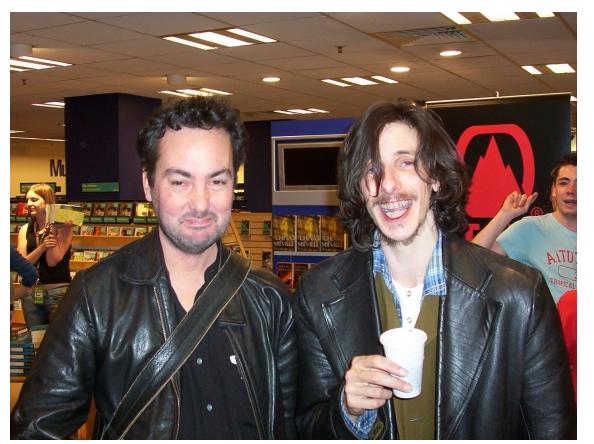
Since the end of the Worldcon, it's occurred to me that my purpose in life is not so much to be a science fiction writer as to provide light comedy relief at science fiction conventions.
This particularly came to mind on the last day of the convention. John Berlyne - the UK Editor for the SFRevu website - had spent most of the weekend trying to organise the filming of a documentary about sf writers and fans, working in conjunction with a chap named Russell.
 Now, by Monday early afternoon, I'd gone several days without adequate sleep, particularly worsened by the fact my convention effectively started a day early with the Nova Scotia launch at Borders on the Wednesday evening.Myself, Mike Cobley, Deborah Miller and Hal Duncan all got squeezed round one side of a dinner table in a restaurant while four people point a camera at us. Which is about the point I started sneezing uncontrollably.
At first it was just the occasional sniff. Then it became a sonic deluge of honks, snorts, sneezes, coughs and splutters, with the added visual effect of increasingly bleary eyes and a lump of paper handkerchief gripped in one hand. By the end of the interview - and my mind was so gone by this point I have serious trouble adequately recalling what I did say - I was a wreck. All I could see were the vaguely horrified expressions of John and his colleagues as I almost literally dissolved before their eyes.
Well, in retrospect, if I'd been able to think more clearly I'd have bowed out and let the other three get on with it, but so it goes. Sorry, Russell. Sorry, John. With any luck you'll be able to salvage at least twenty seconds of usable footage out of, what, forty-five minutes of filming?
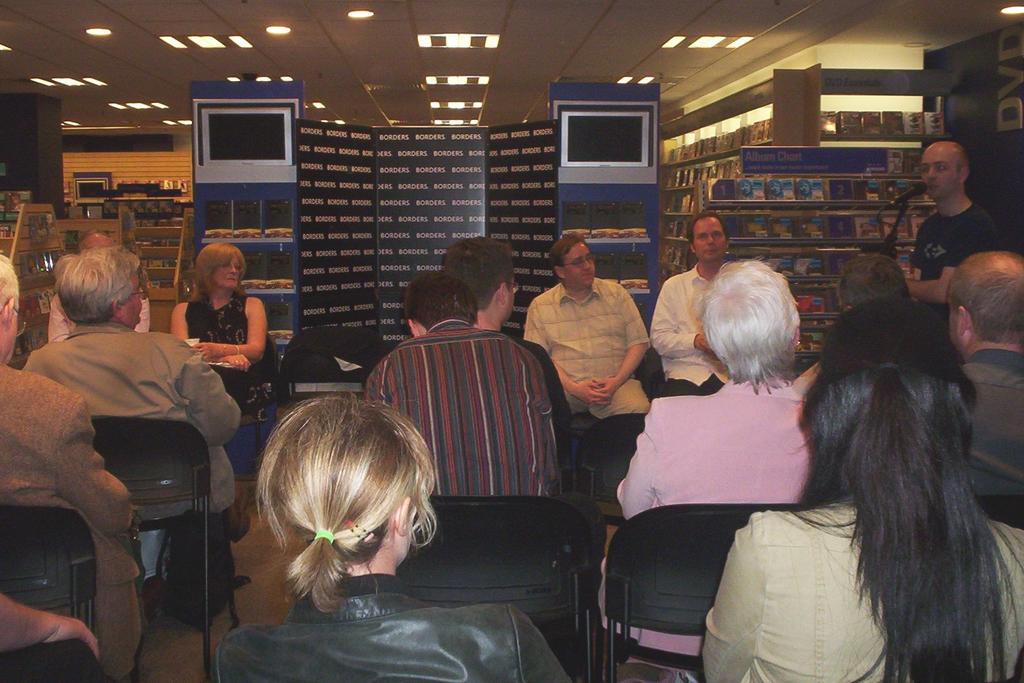 Concerning the documentary: John and Russell are doing the documentary 'on spec', meaning they're not under contract - they're just hoping someone will take it on board at some later date, which I vaguely recollect is often the case with such things. Things I learned: John told me the SFRevu site gets not far off half a million hits a month. I don't know if that's sheerest hyperbole or not, but to me it's very impressive if true. It also makes me wonder what kind of hit rate sites like Sci Fiction get... Anyway, here's a quick breakdown of how things went, day by day:
 WEDNESDAY
(Nova Scotia launch)
Things really kicked off a day early with the launch of the Nova Scotia anthology on the Wednesday: it went pretty well, I think, and most people headed off for the Counting House afterwards. There were certainly a lot of people there.
THURSDAY
(First day of the Con)
I think it was round about this point I knew there was no way in hell we were going to manage a line-up of the whole writer's circle in front of the SECC, and I was right. I managed to get a few photos, but nothing definitive, as it were.
 Plus, I was the first thing on, pretty much: a reading at midday, which went not too badly (at least, I think it didn't) considering I only start functioning around this point most days. It didn't help I didn't really prepare for this, either, so I was kind of jamming/flying by ear on this one. But people tell me it went well enough.
I ran into a lot of people, with particular mention going to Eric Schaler, John Scalzi, Rick Kleffel, Al Reynolds, Ria Cheyne, Jeff Ford, etc, etc, etc.
FRIDAY
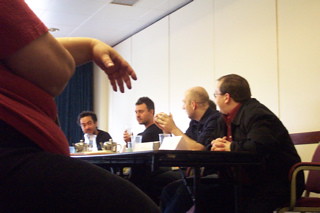
My first real panel, as opposed to the reading the morning before, on scottish writers: apart from myself, there were Richard Morgan, Mike Cobley, Neil Williamson, and Jack Deighton. They argued for the case that there's a recognisable body of scottish sf writing, at least in the cultural sense, and that this is often exemplified by space opera.
I disagreed - rather strongly - pointing out that when you have several men, all from roughly similar socio-economic and cultural backgrounds, they're inevitably going to wind up thinking what they're into somehow represents what's going on in science fiction writing in Scotland. I have my serious doubts that's the case. Later that afternoon, myself, Jay Caselberg (moderating), Keith Brooke, and Martin Sketchley (I think) were on a panel together. Unfortunately, given the late nights that are part and parcel of conventions, what you had were very four tired men saying 'I think ...' and then forgetting what they were about to say. I was the worst. Jay turns to me at one point and says "So Gary. Summing up." To which I look around with an expression that seems to say 'where am I?'
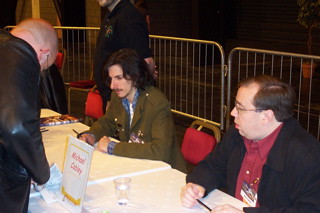
So it goes. The panel was on 'blowing worlds up: the pleasures of destruction', which is pretty vague, so we covered everything from Greg Bear's The Forge of God to JG Ballard's disaster novels, and the idea that the pleasure of destruction of worlds is really about (or so I argued) the innate fear of change, and how this is reflected (as others have noted) in sf's ability to embrace overwhelming change (where 'mainstream' novels, it's been argued, tend to reject it by defeating the agents of change and returning the status quo. Basically any Michael Crichton novel).
OK: so my first ever panel done and dusted. Next up that evening was the Tor UK do at Borders, which went exceedingly well. As I've said before, one of the things that bugged me was the complete lack of any of my books at the convention, despite my second book coming out a couple of weeks ago. Well, I worked out why last night. Like I said before, I don't know the circumstances, but the review copies of Against Gravity went out late. In order to make sure it got reviewed by the magazines, the official release date was moved back a month, despite the fact it was already on sale on the internet and in the bookshops. Because the release date was moved back, it turns out those book dealers who wanted to sell the book at the convention were told by their suppliers the book wasn't available yet ...
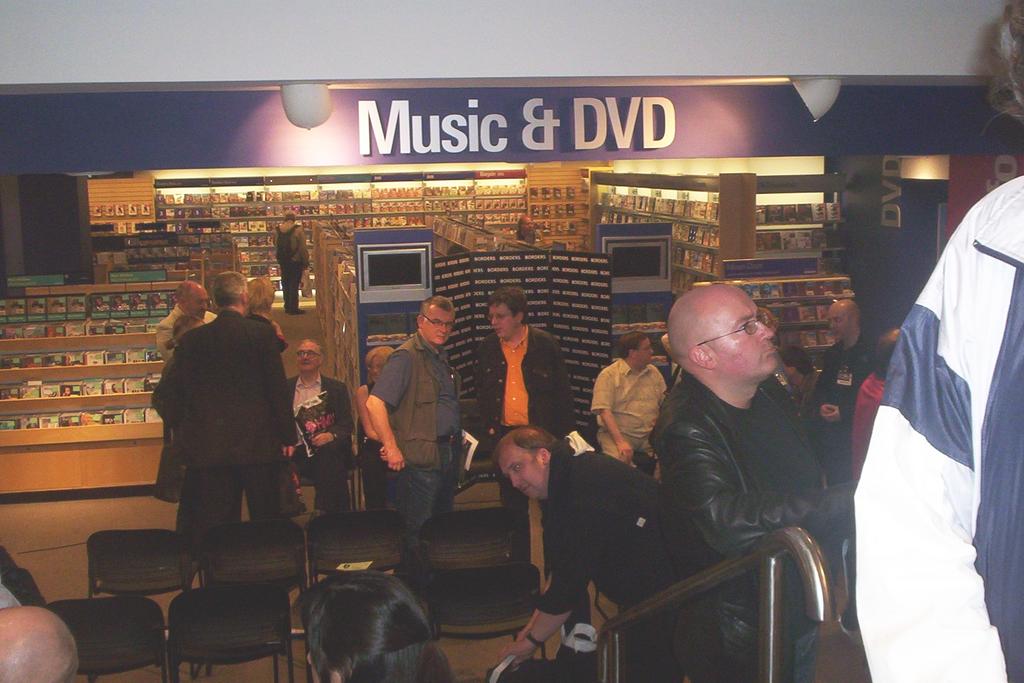
(Through gritted teeth) So. It. Goes.
Meanwhile, copies of Nova Scotia are flying - flying - off the tables. Anyway. Hal got truly and completely smashed (one particularly recalls him bellowing 'I want the finest wines in the house!' across the basement music department). I spent a lot of time chatting to my agent Dorothy Lumley and, of course, my editor Peter Lavery. One good point about this is there were nearly eighty copies of Against Gravity there, about half of which I signed. After
all this, there was a Gollancz party at a club round the corner called Tiger, Tiger. Headed there, along with a good few of the Glasgow contingent, a couple of people from London (hi Gaie, hi Sarah), and MJ, who turned up and effectively became Hal's minder for the night (which mainly involved preventing him from stumbling in front of fast-moving traffic).
I could tell you about how a friend of a well-known writer nearly punched out someone in the industry, but professionalism prevents me. Oh well. Unfortunately, a certain laxity in terms of checking who was going in and out of various industry parties meant one or two people simply wandered in who had nothing to do with the convention. One woman, in particular, was clearly several glass panes short of a greenhouse. At some point, my inner fanboy came out while talking to David Pringle. Who can blame me?The entire first two floors of the Hilton were given over to party space.
The SECC got very quiet after seven or so, and everyone moved on to the Hilton. Good stuff. Lots of people. A Klingon in a kilt, about which I shall say no more. As others have noted - it may have been Ken MacLeod - far less people in silly costumes than in previous years. Naturally, the press showed an unerring ability to zero in on these people as somehow representative of what was otherwise a remarkably sober and industry-oriented affair.
 SATURDAY
As you'll have noticed, I wasn't really going to that many panel items, although I've heard really good things about most of them. I think this might be at least in part because the kind of discussions that go on in panels tend to make up a not insubstantial part of my average Saturday night out.
Also, I view conventions as primarily social events with a vast opportunity to meet'n'greet. I enjoy panels, but I always find myself wondering who I could be chatting to I otherwise wouldn't have the opportunity to chat to for another year or so. I turned up for a Tor UK presentation at ten in the morning, in time for some Nazi in a suit to tell me hot drinks (my coffee from the concourse coffee shop) weren't allowed inside the seminar rooms. Almost certainly blatant rubbish, but I only had the energy to argue with him for a minute or so. I ended up leaving itsitting outside the door: to my surprise, it was still warm an hour later when I re-emerged.
One of the things that stood out was Cecilia Dart-Thornton's presentation around her fantasy book The Iron Tree. Whatever Tor are paying her, it's got to be good, because
she paid the company behind the game Myst to create fully interactive 3D programmed environments based on her books. There were a series of long - perhaps too long - presentations on these. I seem to recall it's possible to get these environments on disk, bundled with one of her books. I think. I think there were publisher parties that night, but I skipped them, already feeling like a zombie. Hit the parties at the Hilton, of course, until the early hours. More Klingons in kilts.
Well, one anyway.
 SUNDAY
At some point I caught Hal doing a reading from Vellum. He started howling when he got to the Iggy Pop bit, which sort of rattled on the eardrums a bit.
Yeah, the Hugos ... got to be honest, I skipped them. An awards ceremony is an awards ceremony. To be honest I regret missing them now, but at the time I was beyond shattered. (On the Monday, in the dealer's room while talking to Mike Cobley, we ran into Charlie Stross, who'd won a Hugo the previous night. He had this glassy-eyed, thousand yard stare about him. The kind of look I imagine I'd have on my face if someone told me I'd won a Hugo.)
Another panel in the afternoon, which I almost forgot I was meant to be on, on breaking into writing. This one went pretty well, actually. Simon Green - author of the Deathstalker books - had a lot to say. His story on writing the novelisation of Prince of Thieves was particularly amusing (apparently the script he was given to work from was particularly appalling. The movie makers had decided that, being set in Britain, the characters would sound more authentic if they said 'bollocks' a lot. The movie novelisation industry being what it is, and the book being written under such a tight deadline, apparently it went to print straight from the word processor to the typesetting machines with only a brief stop at the spellchecker which, unfortunately, turned every occurrence of 'bollocks' into 'bullocks'. And it still made the New York bestseller lists.)
The panel went so well, at the end a member of the audience said it was the best panel of its type they'd been to at a convention. Well, maybe they hadn't been to so many conventions ... we also covered issues like book doctoring, which led on to why outside of a very few trustworthy agencies like John Jarrold's, you should never, ever pay money to companies to publish your work. Money, as they say, flows towards the author, not away. Unfortunately, at least one member of the audience had, it turned out, paid money to put out their work. I don't think anybody had the heart to tell them they'd almost certainly made a big mistake.
I think it was that evening I wound up going to Mother India with pretty much the entire T-Party writer's group from London. Or was it the Saturday? Arse. Can't remember.
Occasional glimpses of Hal going this way and that, usually with some kind of doppler-effect ...aaaaaAAAAAAaaaa... thing going in as he receded once more into the distance.
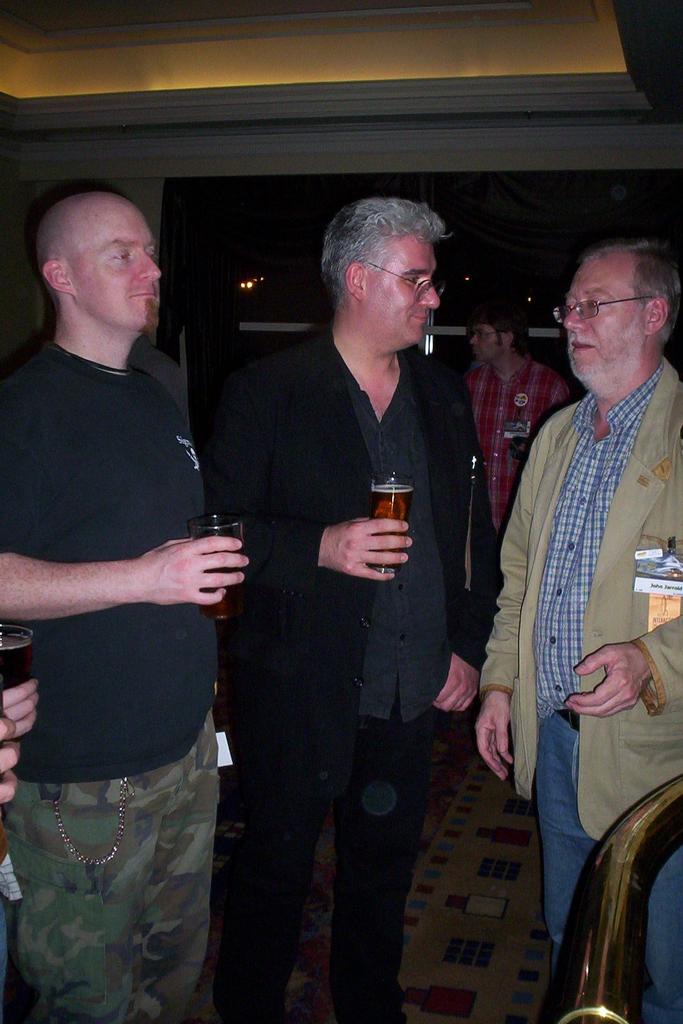 Sunday night led to the best full-on industry party of the week: Orbit's thirtieth anniversary bash at the Arches nightclub in the city centre. This is a movie-maker's idea of what a publishing industry party would be like. One of Glasgow's trendiest clubs and exhibition spaces, stuffed with agents, writers, editors, critics, and me. I managed to blag a couple of friends in with me as well which, to be honest, was pretty easy. Well, okay, we walked in. That's how easy.
 Managed to say hello to a quietly bemused John Scalzi and myself and Andrew Wilson, co-editor of the aforementioned Nova Scotia, managed to press a copy of the aforementioned anthology into Mr Scalzi's hands. This is a good thing, because Scalzi gets a lot of hits on his site, and there's precedent in the fact Scalzi has also sent out copies of his own books for similar promotional reasons to other people who blog. I seem to recall John Scalzi's website gets something like several thousand hits every week or so, which to me is an astonishing figure.
Then the Hugos, which I sat out in the Moathouse chatting to people, after having dinner with an old friend from London I hadn't seen in a long time. Then the inevitable sojourn to the Hilton again, which was interesting: mostly in good ways, but as happens at these things, I did fall out with someone - for very good reasons, from my point of view. So it goes. And then Monday, and the horrible realisation I had to go back to the real world, including the hilarious 'sneezing interview' episode.
 I'd thought about hanging around for the dead dog party, but I skipped it and instead opted to go home and collapse in terminal body shock and enjoy a really stinking cold which kept me horizontal until the next afternoon.
Worldcon!
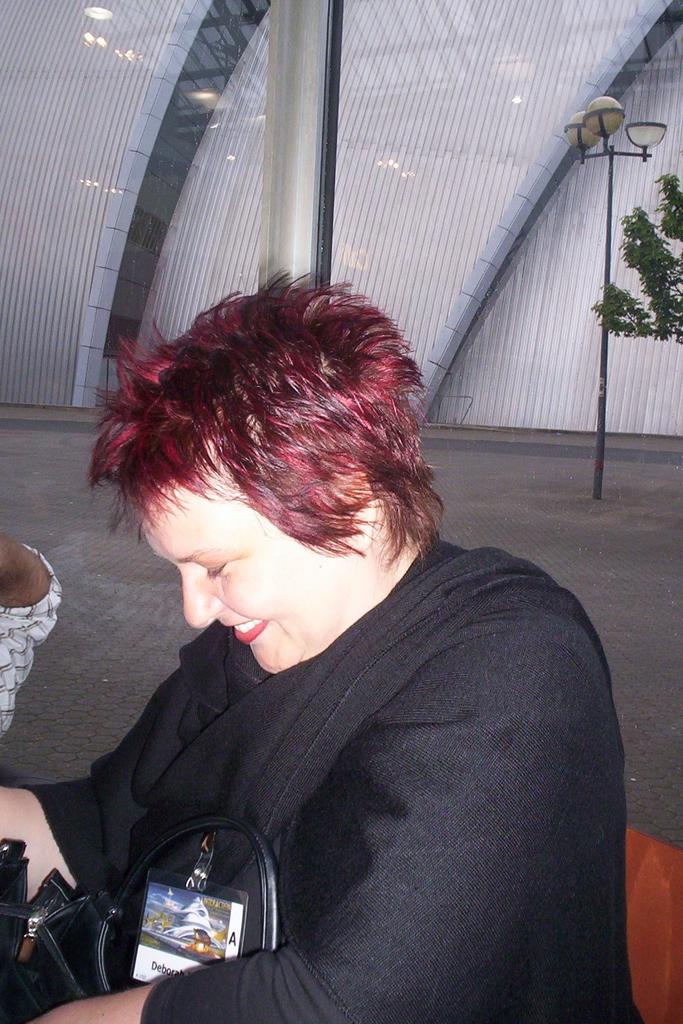
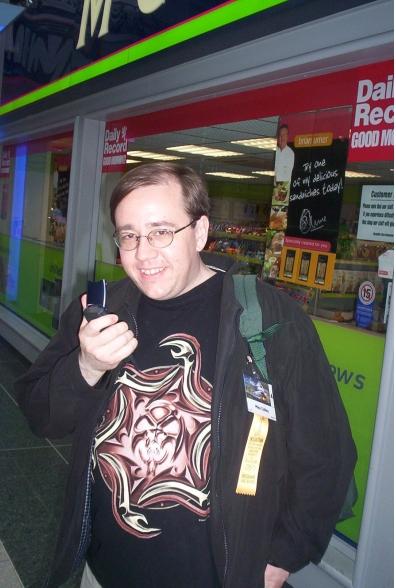
Photos in order: me and Al at the Tor UK do on the Friday: authors read from Nova Scotia at the Wednesday launch: Jim Campbell, Hal Duncan, Gary Couzens at the Nova Scotia launch: preparing for my reading on the Thursday afternoon (thanks Lori!): another photo from the Nova Scotia launch, Paul Cockburn of GSFWC to fore: Hal Duncan and Mike Cobley of GSFWC sign books in the dealer's hall: the Scottish SF panel: Deborah Miller in the concourse: Gavin Inglis, Andrew J. Wilson and John Jarrold chat in the Hilton: and Mike Cobley comes out of the newspaper shop.
8/11/2005
I'm still working on a post about the Worldcon, but knowing my usual procrastination skills, it'll probably be next week before it goes up.
In the meantime, I dropped a line to Joe Gordon over at the Forbidden Planet website about the books, primarily driven by the fact there was one copy of one of my books in the whole dealer's room at a Worldcon taking place almost literally around the corner from my house. Turns out both my books were already featured in FP's instore magazine FPI, for which I am eternally grateful: and Joe already had a piece on them planned for the FP blog/website, which you can find here.
In the meantime, I dropped a line to Joe Gordon over at the Forbidden Planet website about the books, primarily driven by the fact there was one copy of one of my books in the whole dealer's room at a Worldcon taking place almost literally around the corner from my house. Turns out both my books were already featured in FP's instore magazine FPI, for which I am eternally grateful: and Joe already had a piece on them planned for the FP blog/website, which you can find here.
Subscribe to:
Posts (Atom)