5/26/2008

Find Shark, Jump Shark

I saw Indiana Jones and the Crystal Skull on Saturday night. It was like watching a sweded production of a script so terrifyingly bad it had been locked in a steel vault inside a military warehouse far from the eyes of man, but with A-list actors and an actual budget. As I watched my youthful memories of Raiders of the Lost Ark being thoroughly vandalised, I wondered if the stars had been kidnapped for real as well as on the screen; there was a wild-eyed look to Ford et al that made me suspect they were dragged from their Bel Air beds in the middle of the night and forced to perform at gunpoint in some remote Eastern European state.

In the first forty minutes or so, Indiana survives a nuclear explosion by hiding in a fridge, and his son performs a series of Tarzan-like stunts swinging vine-to-vine in the jungle with sufficient Spiderman-like dexterity he catches up with a truck in an action sequence designed to make Scooby Doo cartoons look like bleak exercises in Dogma-style realism. After that, it gets progressively sillier until it achieves a kind of reality-destabilising ur-silliness, whereupon you feel the urge to bite off one of your own fingers and use the stump to scrawl a warning on the floor of the cinema not to watch the movie.

According to an article in The Independent:

"It seems that Spielberg, the director, and Ford, the star, had severe doubts about mystic, crystal skulls as the story line for the new Indiana Jones story, the first to appear since 1989. One of the reasons for the long delay, according to Hollywood gossip, is that Spielberg and Ford hated the skulls idea, put forward by George Star Wars Lucas, who wrote the script. But after a dozen re-writes, they were brought around."


Brought around? Brought around? Bribed? Threatened? The severed heads of Greys mailed to them? Enough money to buy Mexico? Oh Steven, Steven. You might as well drag that festering Jaws prop out of the garage and take a running jump over it.

5/23/2008

No Smoking

Differences between Taipei and home that have begun to seep in: hardly anyone smokes. Walk into a newsagent back home, and there's always a vast, shrine-like display of cigarettes. Hundreds of packets. Walk into a newsagent here - or a 7/11 as they're known - you see about three, stuck up next to the counter. Go into a bar in Glasgow, it's guaranteed to have a mob of people standing and shivering in the rain outside and desperately clutching lit fags. You don't see that anywhere here.

Oh sure, you walk around the streets, and you see one or two people smoking. And I mean one or two. It just doesn't seem to interest people here so much. They just don't seem to be driven to clog up their lungs and everyone else's with foul, polluting smog.

It's nice.

5/21/2008

Oh John Ringo, No

It's book reviews like this one (thanks for the tip, Baz) that make all the rest look utterly insipid by comparison. If Hunter S. Thompson had started reading Robert Heinlein when he was a kid, maybe he'd have ended up writing reviews like this one (of John Ringo's 'Ghost') instead of wasting his time hanging out with movie stars and interviewing famous politicians.

"You think that paragraph alone would make this book awesomely bad, but no. IT GETS MORE SO. Yes, you will be horrified by a lot of this, because Mike Harmon's adventures are by turns awesomely horrific and horrifically awesome; I freely confess that I cannot stop reading these books, because *I have to see what Ringo does next.* I do, however, have a finely-tuned defense mechanism: whenever something trips my circuit breaker, causing me to cringe away from the page, I utter aloud a cry that resets my noggin. You will probably need it yourself, so I provide it here, as a public service: "OH JOHN RINGO NO.

GHOST is Ringo's own admitted Lord King Badfic, his id run wild. By his own account, he was trying to write several books he was actually contracted for, but GHOST kept nudging at him, and finally he just wrote the damn thing to *make it go away* so he could get back to fulfilling his contracts. Ringo locked the spewings of his id away on his hard drive, until he mentioned in passing on an online forum that yeah, he'd written another book, but it was *awful* and would never see the light of day. Naturally, folks were curious, and when Ringo posted a sample, nobody was more surprised than him to find that the response was, more often than not, "Hey, man, I'd buy this."
Be warned - if you read it at work, coffee might spurt through your nose and everyone will give you funny looks. At least, when your jaw isn't dropping open in undiluted horror. And you'll have to resist the urge to mutter, 'Oh John Ringo, no!' at wildly inappropriate moments."

Genius.

5/19/2008

Stealing Light paperback due soon

Just a quick note to say the mass market of Stealing Light will finally be out in the UK on 6/6/08 - about three weeks from now.

This week I have mostly been reading ...

Even though I gave up the idea of buying an e-ink book reader anytime soon a while ago, I've been slowly building what feels like a fairly large collection of openly available works released either by a publisher or by the authors themselves. A lot of them come from Tor, who've been releasing pdf versions of some of their better-known books every week or so in the run-up to their new website. But at last count, there's getting on for two dozen of them. Except they've just been sitting there, since I normally refuse to read a book off a computer screen; waiting for the day when I have something sort of book-like to read them from.

In the end, I broke and started reading them straight from the screen. What made this a lot easier than it might otherwise have been is being able to easily reverse the screen on my ibook with a couple of keystrokes. White text on black is much, much easier on the eyes.

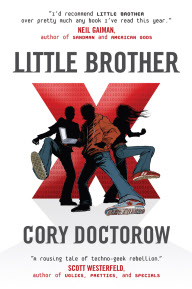
But what's really good is I'm reading a lot more than I have in really quite some time. Of those books I've read so far, the absolute stand-out so far is Cory Doctorow's 'Little Brother'. I read his first two books - which didn't knock me out so much - but Little Brother is quite enormously good. And prescient. Isn't it nice when you can write about a book and get to use words like prescient? I'd say more about it, and use words like unputdownable, astonishing and utterly gripping, but it really deserves a blog entry all on its own.

The experience of reading these freely given books has made me swing more strongly towards the 'give books away for free, and they will come' philosophy. The ebook I read prior to Little Brother was another very well-regarded novel of recent times by another author, but having read it - and admittedly having quite enjoyed it - I didn't feel at all inclined to go and buy anything else by that author. Not because they're necessarily a bad writer, but because they don't give me that 'must buy' feeling I get when I stumble across something really good. By contrast, Little Brother is something I want a physical copy of, on my shelves.

If people aren't reading so much as they used to these days, it's largely an economic issue. It's a pain in the arse to go out and buy a couple of books and find you either don't like them or can't finish them. It's a drain on your wallet - particularly if you're a student or on a low income - a situation I was more than familiar with back in the day.

Buying two, three or more books in a row that you don't like or can't finish makes for an enormous incentive for many people not to buy any more books at all. But if you find something that really knocks you out - the kind of ur-reading experience that has you gripping the pages, desperate to know what happens next - it makes for an enormous incentive to buy everything else by that author. In other words, it creates customer loyalty. Sometimes intense, outspoken customer loyalty, particularly if the book reminds you why you started buying and reading fiction in the first place. And let me assure you, Cory Doctorow's Little Brother is one of those books.

5/16/2008

Google Widgets

Okay - I just stuck a Google widget up on the left hand side of the page that should provide automatic translation into a variety of languages, some of which might even make sense. If you happen to speak one of those languages and what you're reading makes sense, drop me a line in the comments - even just to say 'yes'.

5/08/2008

Waterstone's 'Book of the Month'

Just got an email from my editor Peter Lavery. Every month the UK book chain Waterstone's have a 'book of the month' thing where they promote a book in a particular genre - and Stealing Light, it seems, is going to be the 'sf book of the month' in June, when it comes out as a mass market paperback. Yay me!

5/06/2008

Freeconomics

Since giving stuff away free online is a subject directly related to issues like Digital Rights Management, I found this Guardian interview with Wired editor Chris Anderson on his concept of 'freeconomics' fascinating reading, although I'm not sure I agree with everything he has to say by any means.
"The internet has revolutionised economics," says Anderson down his cellphone as he drives to work in California. "On the web, the marginal costs of manufacturing and distribution are zero, or close to it. This means that you can now experiment with giving away one thing to sell something else much more than you could in the pre-internet era. Or you can experiment with third-party support, where you give away a product to sell attention to another. The traditional model is of giving 1% of goods away as samples in order to sell 99% of the product; on the web, you can give 99% away as free samples to sell 1%." You're kidding, I say to Anderson. And still make profit? "Sure. Why not."

5/05/2008

Two Fingers to DRM

I just spent the better part of a fruitless, irritating, enormously frustrating hour on my girlfriend's windows-running laptop, attempting to make it play a collection of classical music she purchased from the Napster website several months ago. Since then, the computer has been rebooted, and using Napster's 'licence renewal' software to allow her to play that music simply doesn't work. Attempts to update licences by any means results in broken links and crashing software. For legally purchased tracks. By the end of the hour, I felt like picking the laptop up and using it to make a serious dent in something. especially if that something was the soft, squishy, worm-like face of whichever moron thought DRM was a good idea.

In case you're wondering, I regard myself as at least reasonably savvy with a computer (or at least Macs since I dumped Windows for good), but my girlfriend, like the vast majority of people, only needs or wants to know enough to switch hers on, type up documents, play some music while she's prepping for her day's work, and finally switch it off again. Issues like 'DRM' and 'restrictive licensing' are not familiar concepts to her - but they are to me.

This was my first direct encounter with DRM issues, since I only buy physical CD's (which are then ripped to MP3, and therefore act primarily as a backup), and never buy MP3 downloads. The experience left me in absolutely no doubt why people pirate music; the overwhelming feeling I had after all that time wasted trying to help someone play music which they had paid for was that I wanted to stand in front of the main offices of every music business actively supporting DRM and shout fuck you at the top of my voice.

Don't get me wrong, I'm a working writer, and I want to be paid for what I do. I know if I were a professional musician, I'd certainly want to get paid for what I do. I like to believe most people would happily pay for the art, writing and music they value. And although I've felt intellectually DRM is not the way forward for some time, the anger I feel at my encounter with restrictive software provides a certain emotional weight to the issue I hadn't previously experienced. I consider this to be a lesson well learned.

5/03/2008

Britannica for free

The Britannica Encyclopedia recently started handing out free, one-year subscriptions to select online 'publishers' (meaning journalists and bloggers) who were required to submit details of their website or blog as part of the application process. That meant if your blog solely consisted of photographs of Britney's cleavage or an introspective analysis of your growing telepathic commmunion with the cockroaches living under your sink, the chances were you weren't going to get it. Fortunately, being a science fiction writer means you do get it, after a three or four day wait to find out if you make the grade.

Not only that, once you're signed up you can place widgets on your page that not only display a piece of information presumably pertinent to your blog entry, but that also links to the full Britannica article without the need for the casual blog-reader to sign up to it themselves. The same is true for straightforward hypertext links like the one in the next paragraph; click on it and you get the full article - but only that article. But what really matters is I now have full access to Britannica for a year, and that means I can do more research (when I'm not, you know, making stuff up, which is most of the time).

I couldn't help but compare two articles on the same subject, one in Britannica, and one in Wikipedia, on the Chinese god-emperor Fuxi (or Fu Xi, or Fu Hsi); the Britannica info is relatively sparse, but the Wikipedia article is highly detailed. Although it's also quite telling the depth to which the Wikipedia article goes into cinematic representations of Fuxi in a variety of Chinese fantasy films (The reason I'm checking such things is I'm naming two planets after Fuxi and his sister/wife Nuwa. History is apparently unclear on exactly which she was).

On an initial glance, I'd say the Wikipedia article is actually a lot more useful because of the depth it goes into by comparison to the Britannica article. I've heard people complain about the supposed inaccuracy of Wikipedia articles, but those same people never seem to have heard of a little thing called cross-checking.

If you need to make sure your facts are right, check at least two different sources of the same information and see what each says. That's where the value of a free Britannica subscription comes in - although it's own accuracy has been questioned or challenged, and being printed on paper is not in itself an automatic guarantee of such.

My usual research policy is to start with Wikipedia, then either google specific related terms or follow-through some of the online references often found on a Wikipedia page. Sometimes, of course, a trip to a physical library is required, but given I'm living in Asia for the moment, my research is by necessity almost entirely online. Good research, to my mind, means finding not only the commonalities in two sources of information on the same subject, but also gleaning minor but illuminating details to be found only in one or the other.

Now my routine is: check Wikipedia, check what Britannica says by comparison, see what a google search kicks up, ask friends and acquaintances for help if I need any more info related to their particular disciplines (amongst whom I count physicists, game programmers, artificial intelligence researchers, astronomers and those well versed in Babylonian mythology), and work on from there.

4/28/2008

Lonely Planet

While in conversation with a Canadian travel writer of my acquaintance, Troy Parfitt (author of 'Notes From The Other China'), a recently published book by a one-time contributing editor to the Lonely Planet series of travel guides was mentioned. The book is called 'Do Travel Writers Go To Hell', and is by one Thomas Kohnstamm. Turns out he's been featured in a few newspaper articles, and the book sounds interesting enough to go straight into my Amazon wishlist. From an article in the Telegraph:
"The image of the conscientious travel writer has been dealt a blow by a tell-all memoir by a Lonely Planet author, who discloses that he spent more time chasing women and selling drugs than checking train timetables.

Modern guide books like to portray themselves as the definitive source of information on how holidaymakers can enjoy themselves in far-flung corners of the globe without damaging the environment or upsetting local people.

But in a warts-and-all account of how he came to write Lonely Planet's guide to Brazil, the American writer Thomas Kohnstamm has revealed a world where good reviews may be exchanged for sex or a free room for the night, and decisions on which restaurants to include are dependent on the whims of a hard-up author without time to check the details.

In Do Travel Writers Go To Hell?, Mr Kohnstamm, 32, discloses that there was nothing lonely about his three years travelling through Latin America, working on a dozen different titles."

He tries to explain himself here.

Reason No:546 why having the IQ of an amoeba is good news for science fiction writers

It occurred to me the other day, while referring to an online series of photographs of unfinished hotels lost in the Egyptian desert, that I've always had a certain fascination with architecture. This interest stems from my childhood, when I liked to build weird houses out of lego bricks. It reached its culmination in my just pre-teens, when I had to sit an IQ test of some sort. One of the questions - and here, I only vaguely recall something almost certainly coloured and changed by the intervening years, although it stands out sufficiently that I recall little else from that time - involved a series of highly simplified representations of a 'house'. Each drawing consisted of a simple rectangle with a roof - a low triangle - on top. Each had little squares or rectangles for windows, a door and a chimney; each had the door, chimney and windows arranged in different patterns. The question required me to pick whichever was the 'correct' house.

In retrospect, I believe the author of the test required me to pick the rectangle that had four window-squares neatly tucked up close to each corner of the main house-shape; a door, standing at the middle and bottom of the house-shape; and the upright chimney-rectangle positioned on top of the roof but slightly to one side. A classic child's drawing of a house, in other words.

Unfortunately, the author of said question perhaps hadn't anticipated it being answered by a kid obsessed with Marvel Comics and classic science fiction who admired not only the range of architecture evident in films like Logan's Run or Forbidden Planet, who not only held a special place in his heart for the underground lair of the Mole Man, an early nemesis of the Fantastic Four, but had also created several line drawings in the past of his own preferred abode, namely a continental truck-sized mobile home with caterpillar wheels, two levels, a roof-mounted observation bubble, and a tidy little fusion reactor for power where the engine should have been.

I picked a different house for my answer. Not the wrong answer, you understand; another answer. I knew they wanted me to pick the 'right' house, but I was already far too contrary and disinterested in other people's ideas of the right way to do things.

I picked the one with three windows, running in a diagonal line from the top left corner of the house-shape to the bottom right, with the front door squeezed in between the bottom right window and the very edge of the house-shape. My reasoning was simple; obviously the house was open-plan (a personal favourite), with an open stairwell running from one end of an attic-space that had been opened up for a second bedroom down to a front door to one side of the building, while interior dividing walls had been replaced and the supporting columns integrated into the general look-and-feel of the interior space. This struck me as a much more interesting place to live.

I stand by my decision. I suspect that if I'd answered the 'right' way I would now be a moderately successful Call Centre Manager rather than a moderately successful science fiction author. But then, later in life, I did another IQ test out of a book owned by a flatmate and proved to have an IQ of 17, so perhaps you should take anything I say with a pinch of salt.

The point of all this stems from the fact that what most impressed me about my visit to Malaysia was some of the architecture, specifically the twin towers that dominate the skyline there just as much as the equally lofty Taipei 101 tower dominates the skyline of Taipei, in a very science-fictional way. I could tell you about my visit to the bird sanctuary, or my tour around the Chinatown night-market next door to a gigantic mosque, but I can't deny I found myself constantly staring at certain examples of gargantuan architecture with a deep fascination.

So it was with some relief I read an article in the Guardian Online that proves I'm a long, long way from being alone; it seems the British Dan Dare comic strip, with its alien skylines and imagined architecture, was a massive influence on many modern British architects. I like to think the architects mentioned might have sat similar tests, and might also have picked the 'wrong' answer.