Found, on io9.com: a video taken from the front of one of Taipei's over/underground trains as it travels the Neihu line. As the writer on the website says, it's oddly hypnotic. I don't think I ever did actually travel to Neihu while I was living there, but I'm sure I must have been on that part of Taipei's ginormous mass-transit system at some point. But it does all look terribly familiar.

4/10/2011
Taipei
Found, on io9.com: a video taken from the front of one of Taipei's over/underground trains as it travels the Neihu line. As the writer on the website says, it's oddly hypnotic. I don't think I ever did actually travel to Neihu while I was living there, but I'm sure I must have been on that part of Taipei's ginormous mass-transit system at some point. But it does all look terribly familiar.

4/07/2011
Source Code (with spoilers)
Well, I finally caught Source Code, enervated by all the positive reviews, but came away from the cinema feeling let down. Again. There are so many things wrong with the film I almost don't know where to start: I could simply summarise all the issues in this single statement: it makes no sense whatsoever. None of it adds up in any even vaguely rational way whatsoever, which is probably why I spent so much of my time in the cinema staring at the screen in absolute confusion.
I'm going to get spoilery here: Jake Gyllenhaal can travel back in time, into the mind of a dead man, in his last eight minutes of life, so he can figure out who planted the bomb that will blow up the train on which the dead man was/is travelling. No...wait a minute, that's not it: his mind is instead interacting with the residual radiation of a dead man's mind that the Source Code team are somehow able to tap into. The radiation contains, apparently, the dead man's final memories. So it's not time travel after all.
It's true one character states it would take too long to really explain what's going on, and in terms of cinematic shorthand, that's fine: but far, far too many liberties are subsequently taken with logic. If our hero only taps into a dead man's residual memories, why, then, is he tasked with locating a bomb on board a train that was blown up earlier in the day? How could the dead man - a passenger on that train - possibly know himself where that bomb is? How can our hero possibly experience anything objectively real outside of the dead man's subjective experiences unless the train is, in fact, real, and (presumably) in the past?
But we're explicitly and repeatedly warned Source Code is not time travel. Our hero can't change anything in the past. because what's happening isn't in the past...it's in the present.
Isn't it?
Yeah. I'm still scratching my head over that one. Then it gets more ridiculous. Towards the end, our hero learns his body has been reduced to a ruined sack of meat in a tank wired into Source Code's computers. He's technically dead - or at least, reduced to communicating via a terminal wired directly into a part of his brain that hasn't shut down. He demands 'one last chance' to go back into the train and save the passengers - and particularly the Girl. He does. Don't ask me how, since the train isn't meant to be real. Then, somehow, instead of dying when his life support is subsequently switched off (per his wishes) he finds himself alive and hale and continuing on in the (imaginary?) body he's entered.
There's some guff tossed in about how any changes he makes in the past can have no meaning since they can only create an 'alternate reality', except I once again question how this can come about since he is - I recall - not, in fact, travelling through time, merely interfacing with some fading remnant of someone else's mind.
This leads me to the inevitable conclusion that the only way to enjoy a mainstream Hollywood movie these days is, essentially, to pretend you're far, far more stupid than you actually are.
And yet, Duncan Jones - the director of Source Code - previously directed a perfectly acceptable, if not stunningly original, feature film called Moon. District 9 was one of the better movies I've seen in the past few years. Darren Aaronofsky's first film, a low-budget black and white effort called Pi, is easily one of my favourite films, and one of the very few I bothered to buy on DVD. Yet I found Black Swan - a bigger-budgeted, more mainstream affair - to be an atrocious mess.
I see now that the problem is with mainstream Hollywood: District 9, Pi, Moon...they're all 'indie' movies, in the sense at least that they're created on a low budget. There's a sameness to bigger-budget Hollywood films that I don't find in those cheaper, more daring productions: originality becomes smothered by studio demands for a standard three-act structure with a heroic denouement in which the hero always, always gets the girl, even if all laws of logic and sanity have to be tossed out the window in order to achieve it.
So it's indie movies and arthouse flicks for me from here on in. I've been bludgeoned by too much big budget stupidity to want to waste my time with it any more.
One last, highly spoilerific observation for those who have seen Source Code: I experienced overwhelming levels of WTF when our 'hero' has, apparently, taken over the brain of some unsuspecting schoolteacher in order to steal his girlfriend. What the hell happened to him, the schoolteacher?
And how long before our hero's new girlfriend figures out there's someone else entirely lurking inside her boyfriend's skull?
I'm going to get spoilery here: Jake Gyllenhaal can travel back in time, into the mind of a dead man, in his last eight minutes of life, so he can figure out who planted the bomb that will blow up the train on which the dead man was/is travelling. No...wait a minute, that's not it: his mind is instead interacting with the residual radiation of a dead man's mind that the Source Code team are somehow able to tap into. The radiation contains, apparently, the dead man's final memories. So it's not time travel after all.
It's true one character states it would take too long to really explain what's going on, and in terms of cinematic shorthand, that's fine: but far, far too many liberties are subsequently taken with logic. If our hero only taps into a dead man's residual memories, why, then, is he tasked with locating a bomb on board a train that was blown up earlier in the day? How could the dead man - a passenger on that train - possibly know himself where that bomb is? How can our hero possibly experience anything objectively real outside of the dead man's subjective experiences unless the train is, in fact, real, and (presumably) in the past?
But we're explicitly and repeatedly warned Source Code is not time travel. Our hero can't change anything in the past. because what's happening isn't in the past...it's in the present.
Isn't it?
Yeah. I'm still scratching my head over that one. Then it gets more ridiculous. Towards the end, our hero learns his body has been reduced to a ruined sack of meat in a tank wired into Source Code's computers. He's technically dead - or at least, reduced to communicating via a terminal wired directly into a part of his brain that hasn't shut down. He demands 'one last chance' to go back into the train and save the passengers - and particularly the Girl. He does. Don't ask me how, since the train isn't meant to be real. Then, somehow, instead of dying when his life support is subsequently switched off (per his wishes) he finds himself alive and hale and continuing on in the (imaginary?) body he's entered.
There's some guff tossed in about how any changes he makes in the past can have no meaning since they can only create an 'alternate reality', except I once again question how this can come about since he is - I recall - not, in fact, travelling through time, merely interfacing with some fading remnant of someone else's mind.
This leads me to the inevitable conclusion that the only way to enjoy a mainstream Hollywood movie these days is, essentially, to pretend you're far, far more stupid than you actually are.
And yet, Duncan Jones - the director of Source Code - previously directed a perfectly acceptable, if not stunningly original, feature film called Moon. District 9 was one of the better movies I've seen in the past few years. Darren Aaronofsky's first film, a low-budget black and white effort called Pi, is easily one of my favourite films, and one of the very few I bothered to buy on DVD. Yet I found Black Swan - a bigger-budgeted, more mainstream affair - to be an atrocious mess.
I see now that the problem is with mainstream Hollywood: District 9, Pi, Moon...they're all 'indie' movies, in the sense at least that they're created on a low budget. There's a sameness to bigger-budget Hollywood films that I don't find in those cheaper, more daring productions: originality becomes smothered by studio demands for a standard three-act structure with a heroic denouement in which the hero always, always gets the girl, even if all laws of logic and sanity have to be tossed out the window in order to achieve it.
So it's indie movies and arthouse flicks for me from here on in. I've been bludgeoned by too much big budget stupidity to want to waste my time with it any more.
One last, highly spoilerific observation for those who have seen Source Code: I experienced overwhelming levels of WTF when our 'hero' has, apparently, taken over the brain of some unsuspecting schoolteacher in order to steal his girlfriend. What the hell happened to him, the schoolteacher?
And how long before our hero's new girlfriend figures out there's someone else entirely lurking inside her boyfriend's skull?
3/24/2011
Tentacles of Dawn
Turns out Rainn Wilson is the son of a science fiction writer, Robert Wilson (no, not Anton or Charles), who had one novel out in the Seventies. Not one of the good ones, by the sound of it.
3/18/2011
Rango
I'm not much of one for writing movie reviews, mainly because I'm lazy, but myself and Emma were checking out the listings for something cool to see, and it came to a choice between Fair Game (interesting-looking thriller based on a true story), The Adjustment Bureau (based on a PK Dick story), and...Rango, an animated CGI comedy about a chameleon that's also a spoof on the Western Genre. Given that I feared Adjustment Bureau might wind up with me spitting out my own teeth if they did (as has been hinted) ass-rape the corpse of Phil Dick by turning it into what looks suspiciously like an inoffensive light romantic thriller, it was only really a choice between two. And Rango is voiced by Johnny Depp, a man with a pleasing habit of choosing some fairly off-beat cinematic projects to get involved in. So Rango it was.
Do you know what I mean when I say there are moments in a film when your brain says 'Sold'? It's a line, an image, something that makes you think: I'm in. Whatever you do from here on in is okay by me.
I fear becoming SPOILERISH at this point but the scene I'm about to describe occurs at the opening of the movie, and gives away little. Rango - the chameleon voiced by Depp - has, along with the glass case that has been his home until now, been sent tumbling out of the rear of a car on some lonely midwest highway. He is sent bouncing around the road, and between cars and trucks, surviving at improbable odds. At one point he splats onto the windscreen of an open-top convertible, with his head stuck inside a plastic smiley face.
With Hunter S. Thompson at the wheel.
And Dr Gonzo in the back.

And with that, I was won over. They're even wearing the same goddamn Hawaiian shirt. But it's that same out-there-ness that ultimately works against the picture's chances of success: is it a kid's picture, or an adult film masquerading as a kid's picture? Hard to tell. I enjoyed it, although the story was a little uneven in places, and I'd certainly watch it again (Hunter/Duke is not the only real-life character to get an unnamed cameo), and it's without doubt a hell of a lot more original than much of what comes out of Hollywood these days. Do I recommend it? Yes, absolutely, and it frequently steers into the wildly surreal in a manner I find highly entertaining, but it does seem to be trying to be two things at once.
But that scene, near the beginning. I laughed out loud and resisted the urge to start clapping, thereby making myself look like a total freak. Maybe I was the only one who got it, maybe not; most of the audience were students, whom, I rather suspect, are this film's true target audience.
Do you know what I mean when I say there are moments in a film when your brain says 'Sold'? It's a line, an image, something that makes you think: I'm in. Whatever you do from here on in is okay by me.
I fear becoming SPOILERISH at this point but the scene I'm about to describe occurs at the opening of the movie, and gives away little. Rango - the chameleon voiced by Depp - has, along with the glass case that has been his home until now, been sent tumbling out of the rear of a car on some lonely midwest highway. He is sent bouncing around the road, and between cars and trucks, surviving at improbable odds. At one point he splats onto the windscreen of an open-top convertible, with his head stuck inside a plastic smiley face.
With Hunter S. Thompson at the wheel.
And Dr Gonzo in the back.

And with that, I was won over. They're even wearing the same goddamn Hawaiian shirt. But it's that same out-there-ness that ultimately works against the picture's chances of success: is it a kid's picture, or an adult film masquerading as a kid's picture? Hard to tell. I enjoyed it, although the story was a little uneven in places, and I'd certainly watch it again (Hunter/Duke is not the only real-life character to get an unnamed cameo), and it's without doubt a hell of a lot more original than much of what comes out of Hollywood these days. Do I recommend it? Yes, absolutely, and it frequently steers into the wildly surreal in a manner I find highly entertaining, but it does seem to be trying to be two things at once.
But that scene, near the beginning. I laughed out loud and resisted the urge to start clapping, thereby making myself look like a total freak. Maybe I was the only one who got it, maybe not; most of the audience were students, whom, I rather suspect, are this film's true target audience.
3/11/2011
On a slightly more sober note
Watching the footage, live, from Japan: scary stuff, especially when you see a car belting down a highway away from the surge of junk and water spreading across fields on that country's East coast. After a couple of years in Taiwan, I'd only rarely experienced tremors, but one of the things that I remember is the eerie silence of it all. Things shake, but more or less soundlessly. '70's epics like 'Earthquake' on some subliminal level caused me to believe the air would be filled with a constant RRAARRRR but it's not so.
If you want to get some idea what it feels like, stand on a table and get four people to stand around you, jerking the thing from side to side. That's pretty much what it feels like.
At some point, some of those waves are likely to hit Taiwan, but I don't expect them to have too many problems. People on the Japanese coast only had a few minutes warning before the waves hit, but Taiwan'll have hours to prepare before the waves reach their low-lying coastal areas.
UPDATE: According to someone reporting from Taipei (Taiwan), the time at which the waves were expected has come and passed with no significantly damaging coastal activity. They're not definitely in the clear just yet since this depends (according to the BBC News) on such things as sub-aquatic topography that might slow things down, but for the moment they've lifted their tsunami warning.
If you want to get some idea what it feels like, stand on a table and get four people to stand around you, jerking the thing from side to side. That's pretty much what it feels like.
At some point, some of those waves are likely to hit Taiwan, but I don't expect them to have too many problems. People on the Japanese coast only had a few minutes warning before the waves hit, but Taiwan'll have hours to prepare before the waves reach their low-lying coastal areas.
UPDATE: According to someone reporting from Taipei (Taiwan), the time at which the waves were expected has come and passed with no significantly damaging coastal activity. They're not definitely in the clear just yet since this depends (according to the BBC News) on such things as sub-aquatic topography that might slow things down, but for the moment they've lifted their tsunami warning.
My Favourite Tweet, So Far
You got to love this one, picked up by a search filter I set up on Twitter a while ago:
(For a translation, go here)
"My dads about me on fb is "reading nova war by gary gibson" lol wtf father this is a social networking site not a bloody book club"Lol, wtf, indeed, @marquezfan. And if you're reading this...
n, may I also +, yr dad hs xpressd phat taste n hs readN material, + I do hope he keeps posting 2 FB whnvr he chooses 2 read 1 of my bux.
(For a translation, go here)
2/27/2011
Plan B
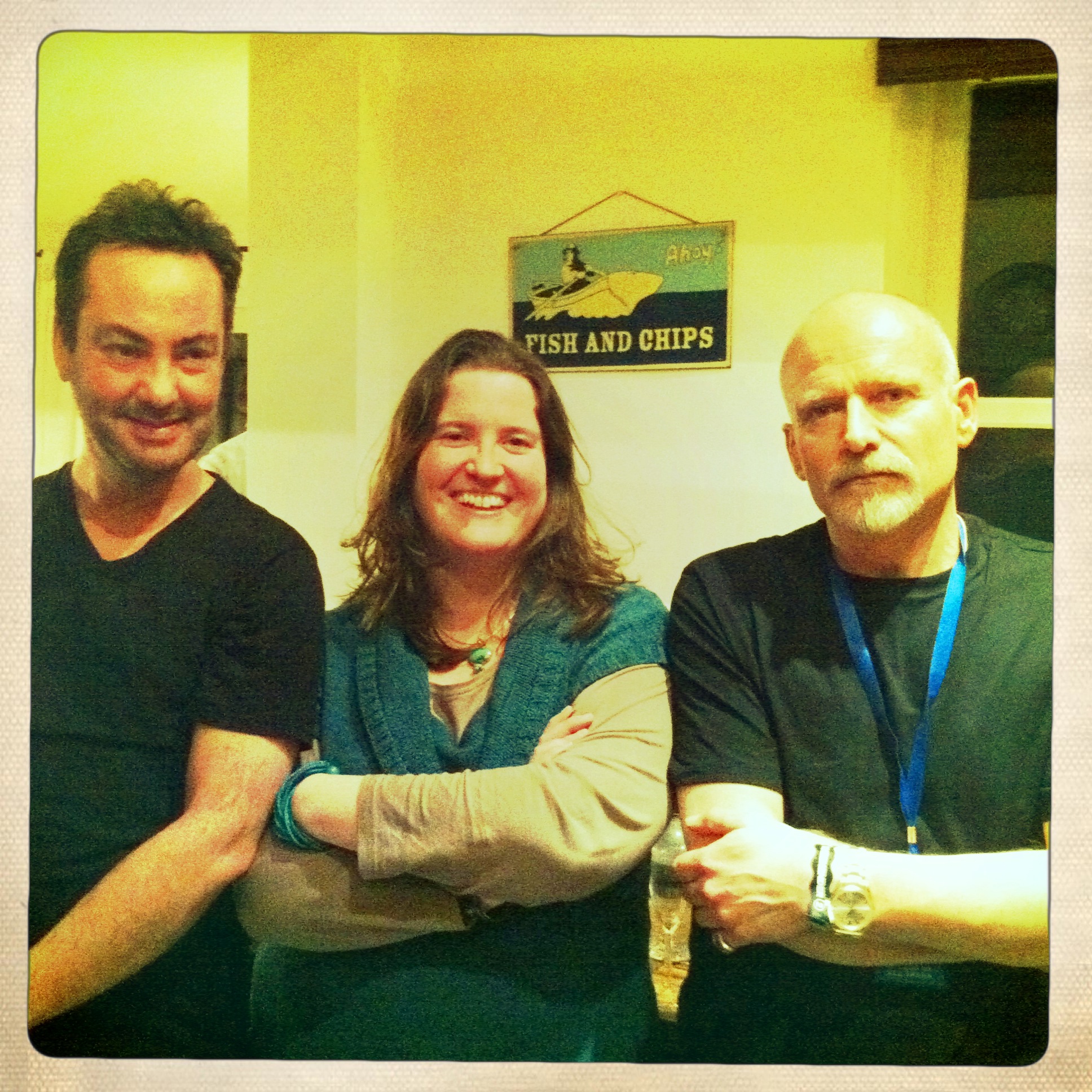
The talk at Plan B books in Glasgow city centre went really quite well, and it was also an opportunity to catch up with Richard Morgan, whom I hadn't spoken to in a couple of years. We had a good, decent-sized audience, and there was a mixture of faces both familiar and new; unfortunately I had to dive out for twenty minutes immediately following the talk, and it's possible I didn't get the chance to sign books for one or two members of the audience - sorry about that, if that was the case. You'd think it would be hard to fill up a full three hours just talking about writing, but it's surprisingly easy, actually, and between the three of us, with questions from Will Couper, who acted as our host, things rolled along rather nicely.
Here's a picture from the event, courtesy of Mark Harding:

Here's a picture from the event, courtesy of Mark Harding:

2/24/2011
Teaching SF and Q&A with Hal Duncan and Richard Morgan
Just a heads-up to say I'm going to be teaching a couple of summer evening and afternoon classes, in July and August this year, at Strathclyde University in Glasgow. One is a workshop/writing class, the other is on 'understanding sf', essentially a primer on the field. I don't have the exact dates and so forth just yet, and neither has the cost of the classes been established so far, but I can tell you that each class will run over two consecutive weeks, comprising two classes That means there's going to be a lot packed in to a fairly short space of time, but it's my intention to cram people's heads full of as much incredibly cool stuff as I possibly can. Assuming things go well, this'll hopefully lead on to longer classes in the latter part of the year, running over several weeks.
Remember also that I'll be at Plan 9 Books in Glasgow, on Saturday afternoon, from about 1pm onwards, in conversation with Hal Duncan (Vellum, Ink) and Richard Morgan (Altered Carbon, Thirteen). Plan B, as well as selling books and comics of a distinctly indie bent, also has an excellent little coffee shop built into it, so you'll be assured of being in comfortable surroundings.
Remember also that I'll be at Plan 9 Books in Glasgow, on Saturday afternoon, from about 1pm onwards, in conversation with Hal Duncan (Vellum, Ink) and Richard Morgan (Altered Carbon, Thirteen). Plan B, as well as selling books and comics of a distinctly indie bent, also has an excellent little coffee shop built into it, so you'll be assured of being in comfortable surroundings.
2/21/2011
Stupid Idea of the Day 2
I got up earlier than usual today, and my brain isn't really talking to me, so blame it, not me, for what's being written here. I had nothing to do with it. My fingers are protesting at having to type these very words. There. You can't see it, but one of my hands just gave me the finger.
Yeah. Same to you, finger.
Anyway. It must be early, because this is a truly stupid idea, and also a really, really, really old one already far past its sell-by date. It's this: bring back Celebrity Big Brother, but give it a different name, put it on BBC4 and fill it with writers. Martin Amis, Jeanette Winterson, Kazuo Ishiguro, and whoever else you can think of. Lock them in there with access to only one manual typewriter and a limited daily allowance of paper.
Then lightly salt with 'surprise' house guests, particularly book critics. Preferably ones with a habit of writing excoriating reviews. Then get them all to vote each other out not on the basis of how well they get on, but on what they think of what each of them has written that day (limited amounts of paper, say ten sheets each, means they can't spend all day hiding behind the typewriter. Hopefully, anyway). Sort of like a writer's workshop crossed with Rollerball. You could call it Last Author Standing.
Now there's an image that's going to stay with me for a while.
I swear, there'd be blood on the walls. I'd be glued all day. Plus, you'd get something resembling intelligent conversation between people who have enough intelligence to know that Madagascar is a real place, and not just an animated movie.
My fingers would like to inform you this all occurred to me after making a crack about how sharing a cottage with Adrian Tchaikovsky, Paul Cornell, China Mieville, Peter Hamilton and Mark Newton at the SFX Weekender might be compared to a sort of SF/fantasy Celebrity BB house, minus the cameras and bitching. Not that it was really like that, but we spent a lot of time sitting around the kitchen table talking.
Yeah. Same to you, finger.
Anyway. It must be early, because this is a truly stupid idea, and also a really, really, really old one already far past its sell-by date. It's this: bring back Celebrity Big Brother, but give it a different name, put it on BBC4 and fill it with writers. Martin Amis, Jeanette Winterson, Kazuo Ishiguro, and whoever else you can think of. Lock them in there with access to only one manual typewriter and a limited daily allowance of paper.
Then lightly salt with 'surprise' house guests, particularly book critics. Preferably ones with a habit of writing excoriating reviews. Then get them all to vote each other out not on the basis of how well they get on, but on what they think of what each of them has written that day (limited amounts of paper, say ten sheets each, means they can't spend all day hiding behind the typewriter. Hopefully, anyway). Sort of like a writer's workshop crossed with Rollerball. You could call it Last Author Standing.
Now there's an image that's going to stay with me for a while.
I swear, there'd be blood on the walls. I'd be glued all day. Plus, you'd get something resembling intelligent conversation between people who have enough intelligence to know that Madagascar is a real place, and not just an animated movie.
My fingers would like to inform you this all occurred to me after making a crack about how sharing a cottage with Adrian Tchaikovsky, Paul Cornell, China Mieville, Peter Hamilton and Mark Newton at the SFX Weekender might be compared to a sort of SF/fantasy Celebrity BB house, minus the cameras and bitching. Not that it was really like that, but we spent a lot of time sitting around the kitchen table talking.
2/16/2011
Outcasts
I actually quite like the theme of the series (Outcasts), the idea of whether or not the human race would make the same mistakes, given a chance to start over somewhere else. It's something I've been working towards for a while, even if it's not particularly obvious or evident in my stuff. But in so many respects it's a weird show, perhaps because the writer is clearly far from au fait with either science fiction or indeed science, even the sketchy pop-quiz level of knowledge that most authors get by with. Actually, a better word for it might be 'bizarre'.
It's set in the mid-21st century, barely forty years from now, and we've somehow managed to cross untold light years on board enormous ships that are way beyond blue-sky at the current moment.
There appear to be no vehicles in or around the settlement. They got there by spacecraft, but otherwise appear to walk everywhere. Okay, limited resources, but if they can clone pigs...why not horses?
They have some kind of mobile comms tech that mysteriously operates fine within the settlement's boundaries, but which they mysteriously fail to use once they leave town to look for people who should be eminently traceable using existing and dirt-cheap technology. Of course, half of the story lines would then cease to exist.
There's a kid genius who listens to the Sex Pistols, leading me to the suspicion he's really seventy-five and very youthful-looking for his age.
There's an 'earth mast' for communication with home, as opposed to, say, a cheap satellite. There's a moon or nearby planet so close they look like they're about to hit each other. We've somehow managed to grow fully adult human clones with special genetic abilities and ship them to another planet and get reports back from there, sometime in the next 40 years, so far as I can judge, at rather less than light speed.
A lot of things can be put down to budgetary restrictions, no doubt. There are many things that could, with just a tiny bit of effort, be easily explained away.
I could get annoyed, but I'm too weary. Fish, barrel, shotgun. You know the drill. I can actually picture the manuscript report I could put together for the guy behind this series, and the list of recommended reading regarding plausible back-grounding I'd give him. Nothing technical, just a couple of book titles, non-fiction plus a smattering of novels by people who actually manage to write this stuff in a believable way. Then I'd explain why these mistakes would kill any chance of his getting his novel published because he'd be laughed out of print. Then I remember he's not a novelist but a script writer; a new writer on a prime time BBC drama can pull down, at minimum, something like thirty grand per hour-long episode. That's a couple of hundred k for writing something pretty much any print publisher or agent in the land would bounce right back out the door for lack of plausibility, insufficient world building and confusing story structure.And yet there it is, on our television screens.
There is, I remind myself, no point in getting annoyed.
It's set in the mid-21st century, barely forty years from now, and we've somehow managed to cross untold light years on board enormous ships that are way beyond blue-sky at the current moment.
There appear to be no vehicles in or around the settlement. They got there by spacecraft, but otherwise appear to walk everywhere. Okay, limited resources, but if they can clone pigs...why not horses?
They have some kind of mobile comms tech that mysteriously operates fine within the settlement's boundaries, but which they mysteriously fail to use once they leave town to look for people who should be eminently traceable using existing and dirt-cheap technology. Of course, half of the story lines would then cease to exist.
There's a kid genius who listens to the Sex Pistols, leading me to the suspicion he's really seventy-five and very youthful-looking for his age.
There's an 'earth mast' for communication with home, as opposed to, say, a cheap satellite. There's a moon or nearby planet so close they look like they're about to hit each other. We've somehow managed to grow fully adult human clones with special genetic abilities and ship them to another planet and get reports back from there, sometime in the next 40 years, so far as I can judge, at rather less than light speed.
A lot of things can be put down to budgetary restrictions, no doubt. There are many things that could, with just a tiny bit of effort, be easily explained away.
I could get annoyed, but I'm too weary. Fish, barrel, shotgun. You know the drill. I can actually picture the manuscript report I could put together for the guy behind this series, and the list of recommended reading regarding plausible back-grounding I'd give him. Nothing technical, just a couple of book titles, non-fiction plus a smattering of novels by people who actually manage to write this stuff in a believable way. Then I'd explain why these mistakes would kill any chance of his getting his novel published because he'd be laughed out of print. Then I remember he's not a novelist but a script writer; a new writer on a prime time BBC drama can pull down, at minimum, something like thirty grand per hour-long episode. That's a couple of hundred k for writing something pretty much any print publisher or agent in the land would bounce right back out the door for lack of plausibility, insufficient world building and confusing story structure.And yet there it is, on our television screens.
There is, I remind myself, no point in getting annoyed.
2/10/2011
Why China (might) never rule the world
Troy Parfitt is a Canadian writer I first got to know in Taipei through my wife; they taught at the same school for several years. I've read and enjoyed Troy's previous book, Notes from the Other China, although I understand that some of his observations in that book caused some minor controversy. His follow-up, Why China Will Never Rule The World, is coming out later this year, and in it he's going to attempt to present a thesis on why he doesn't think China is going to present nearly the economic threat to the West - or indeed the rest of the world - that many seem to believe. Given that I spent a couple of years in considerable proximity to China (although the closest I got to actually visiting the place consisted of nothing more than a couple of trips to Hong Kong), I find the whole debate quite fascinating.
Troy's put together a promotional video where he talks about the thinking behind the book. You might have to use the password 'china' to access it.
There's an excerpt from the book here. Another book worth reading on the subject of China is The Man Who Loved China, by Simon Winchester, a biography of Joseph Needham.
Troy's put together a promotional video where he talks about the thinking behind the book. You might have to use the password 'china' to access it.
China from Tyler Ellis on Vimeo.
There's an excerpt from the book here. Another book worth reading on the subject of China is The Man Who Loved China, by Simon Winchester, a biography of Joseph Needham.
2/08/2011
SFX Weekender
Well, that was a blast. I just spent the weekend being a guest at this year's SFX Weekender at Camber Sands, not far from Brighton. I'll be honest - the location struck me as being a bit bleak and remote, although that was as much a function of the time of year and the howling winds sweeping along the beaches nearby as much as anything else.
There were a lot of people there, and it's easily one of the biggest cons I've ever been at, barring a couple of Worldcons. I understand there were between two and three thousand people there over two days, but if you told me there were more, it wouldn't surprise me.
The moment I'll most remember? The rabbit-in-the-headlights experience of finding myself on a huge stage in front of several hundred people, and quite possibly more, hearing my voice boom out across this vast freaking hall, just an hour or two after Chloe from Tor had picked me up from the train station at Rye. I was taking part in a panel on 'science in science fiction' and, as interesting as it was, it was also just a tiny bit overwhelming. I turned to my right - I was bang in the middle of the line-up behind a long desk - and saw Stephen Baxter and Peter Hamilton. To my left, China Mieville, Paul Cornell and Kevin J. Anderson. All speaking with an air of confidence and erudition that was, for want of a better word, challenging.
Dear god. Rabbit in the headlights for sure. The sound wasn't as good as it could be and for much of the hour I was up there, the audience was in fact mostly invisible due to extremely powerful lights shining onto the stage. It reminded me of a conversation I'd had with a friend who performed in various metal bands way back in the Eighties; I'd asked him if he ever got nervous up on stage, and he replied that most of the time you couldn't even see the audience, so that took a lot of pressure off. He was right.
The sound problems - including a heavy echo across this vast, hangar-sized room - meant I had to keep leaning over to hear what people next to me were saying. Every time I turned towards China on my left, I kept getting distracted by the highly detailed tentacle tats wrapped around his arm. The rest of them had an admirable rapport with the audience, indicating they had considerably more con panel experience than I've yet managed to muster even in several years as a writer.
Given the circumstances, I made a point of not saying anything unless I could make it as clear and cogent and pointed as possible. Unfortunately, by the time I felt like I was starting to relax, the panel was just about over. And that was my only panel, apart from a signing session in the company of all the other Tor writers the next afternoon, which went about as well as I'd expected.
Some observations about the con itself: I didn't actually see a great deal of it, since the majority of the time, myself and the other Tor writers were at a cottage our editor Julie Crisp had hired just down the road from the holiday camp. Tor UK threw a party on the Friday night, where most of the Orbit crew turned up, and a lot of other people. It got pretty crowded, and proved to be a good night. I had excellent company over the weekend - my editor Julie Crisp, Chloe and Amy, also China Mieville, Mark C Newton, Paul Cornell (with whom I shared a room), Adrian Tchaikovsky and, of course, the iridescently-waist-coated Peter Hamilton.
Here's one thing that did particularly strike me about SFXW: it reminded me so much of the conventions I first went to, back in the early/mid Eighties. My first ever con was in Glasgow, maybe in 1982 - an Albacon, I think - and I've gone to them more or less regularly ever since. Contrast that with a lot of pro writers at SFXW for whom this was apparently only their first, second or third convention.
Back in those days, you had all kinds of fandom present. There were people like myself who were primarily into fiction, but there were also Star Trek fans, Star Wars fans, comic fans, and every other kind of fan; movies, media, and books, all mixed in together. Over the next several years many of these groups evolved their own media-related cons and the attendance at specifically sf cons such as Eastercon grew more specific and also smaller. This led into what's been described as the 'greying' of fandom, as younger fans fail to attend.
SFXW wasn't like that at all. Those attending were split roughly equally half and half in terms of males and females, and the majority were also refreshingly youthful. There were even quite a few families. These are people who I suspect certainly read plenty of sf but love their movies, comics and tv shows just as much. On top of that, the organisers put on a terrific show the likes of which I have never experienced at any con. There was a sense of fun I haven't felt since I was a teenager attending my very first cons.
That's not to say I don't have one or two criticisms, though they are relatively minor ones. The SFX awards ceremony started off with dancing girls in bikinis. All I'm saying is, this is the 21st Century, folks, and for me science fiction is supposed to be about looking forward to an era of equality and balance. Instead I felt like I'd fallen into some sf-oriented version of a night club straight out of Mad Men. There was, at times, a level of objectification of women that made me just a tiny little bit uncomfortable. Or possibly more than a tiny bit. If you're going to have dancing girls, you might as well balance it out and have male dancers of a similar style as well, otherwise there's the risk of engaging in some pretty blatant stereotyping not only of the women concerned, but ultimately of the fans too. I know the portrayal of women in this way isn't a phenomenon limited to certain aspects of the sf genre - I've been to computer trade shows in Taiwan and, believe me, they're probably worse in this respect - not to mention endless newspaper shots of some new sports car with a half-naked model draped across it - but that doesn't necessarily make it right.
Also, I think I mentioned the location - a Pontin's holiday camp, in early February, for God's sake - was kind of bleak. Also, to put it mildly, out of the way. I had to fly down to London the previous night, stay in a hotel, get up at the crack of dawn, take a train to Brighton, then switch to another train to Rye that took waaaay longer than I thought it would, then get a lift from Rye to the camp three miles away. I can imagine the logistics of putting on an event like this are fairly horrendous, however, and with any luck the event will take off well enough in the future that SFX might be able to find a more central or urban location. It's a tribute to them that they managed to pull things off quite so well as they did given the circumstances.
If there's one advantage institutions like Eastercon still have, it's that they largely take place in hotels, which provide endless opportunities for socialising and meeting new people either in corridors, bars or at the many, many room parties. SFXW, on the other hand, took place in a large echoing hall (plus a tiny pub next door), physically separated from the rather barracks-like buildings surrounding it. Getting from one to the other meant fighting your way through a bitter, howling gale coming straight off the sea. Nonetheless, I think there's a very, very, very great deal trad cons could learn from an event like SFXW, and I came away thinking cons like this are going to lead the way in the coming years. It was enormously fun, and I'd do it again in a flat second.
There were a lot of people there, and it's easily one of the biggest cons I've ever been at, barring a couple of Worldcons. I understand there were between two and three thousand people there over two days, but if you told me there were more, it wouldn't surprise me.
 |
| Via Mark Newton's blog: giant robot terrorizes audience. |
Dear god. Rabbit in the headlights for sure. The sound wasn't as good as it could be and for much of the hour I was up there, the audience was in fact mostly invisible due to extremely powerful lights shining onto the stage. It reminded me of a conversation I'd had with a friend who performed in various metal bands way back in the Eighties; I'd asked him if he ever got nervous up on stage, and he replied that most of the time you couldn't even see the audience, so that took a lot of pressure off. He was right.
The sound problems - including a heavy echo across this vast, hangar-sized room - meant I had to keep leaning over to hear what people next to me were saying. Every time I turned towards China on my left, I kept getting distracted by the highly detailed tentacle tats wrapped around his arm. The rest of them had an admirable rapport with the audience, indicating they had considerably more con panel experience than I've yet managed to muster even in several years as a writer.
Given the circumstances, I made a point of not saying anything unless I could make it as clear and cogent and pointed as possible. Unfortunately, by the time I felt like I was starting to relax, the panel was just about over. And that was my only panel, apart from a signing session in the company of all the other Tor writers the next afternoon, which went about as well as I'd expected.
 |
| Me, Orbit's Anne & JC Grimwood, via the Orbit blog |
Here's one thing that did particularly strike me about SFXW: it reminded me so much of the conventions I first went to, back in the early/mid Eighties. My first ever con was in Glasgow, maybe in 1982 - an Albacon, I think - and I've gone to them more or less regularly ever since. Contrast that with a lot of pro writers at SFXW for whom this was apparently only their first, second or third convention.
Back in those days, you had all kinds of fandom present. There were people like myself who were primarily into fiction, but there were also Star Trek fans, Star Wars fans, comic fans, and every other kind of fan; movies, media, and books, all mixed in together. Over the next several years many of these groups evolved their own media-related cons and the attendance at specifically sf cons such as Eastercon grew more specific and also smaller. This led into what's been described as the 'greying' of fandom, as younger fans fail to attend.
SFXW wasn't like that at all. Those attending were split roughly equally half and half in terms of males and females, and the majority were also refreshingly youthful. There were even quite a few families. These are people who I suspect certainly read plenty of sf but love their movies, comics and tv shows just as much. On top of that, the organisers put on a terrific show the likes of which I have never experienced at any con. There was a sense of fun I haven't felt since I was a teenager attending my very first cons.
That's not to say I don't have one or two criticisms, though they are relatively minor ones. The SFX awards ceremony started off with dancing girls in bikinis. All I'm saying is, this is the 21st Century, folks, and for me science fiction is supposed to be about looking forward to an era of equality and balance. Instead I felt like I'd fallen into some sf-oriented version of a night club straight out of Mad Men. There was, at times, a level of objectification of women that made me just a tiny little bit uncomfortable. Or possibly more than a tiny bit. If you're going to have dancing girls, you might as well balance it out and have male dancers of a similar style as well, otherwise there's the risk of engaging in some pretty blatant stereotyping not only of the women concerned, but ultimately of the fans too. I know the portrayal of women in this way isn't a phenomenon limited to certain aspects of the sf genre - I've been to computer trade shows in Taiwan and, believe me, they're probably worse in this respect - not to mention endless newspaper shots of some new sports car with a half-naked model draped across it - but that doesn't necessarily make it right.
Also, I think I mentioned the location - a Pontin's holiday camp, in early February, for God's sake - was kind of bleak. Also, to put it mildly, out of the way. I had to fly down to London the previous night, stay in a hotel, get up at the crack of dawn, take a train to Brighton, then switch to another train to Rye that took waaaay longer than I thought it would, then get a lift from Rye to the camp three miles away. I can imagine the logistics of putting on an event like this are fairly horrendous, however, and with any luck the event will take off well enough in the future that SFX might be able to find a more central or urban location. It's a tribute to them that they managed to pull things off quite so well as they did given the circumstances.
If there's one advantage institutions like Eastercon still have, it's that they largely take place in hotels, which provide endless opportunities for socialising and meeting new people either in corridors, bars or at the many, many room parties. SFXW, on the other hand, took place in a large echoing hall (plus a tiny pub next door), physically separated from the rather barracks-like buildings surrounding it. Getting from one to the other meant fighting your way through a bitter, howling gale coming straight off the sea. Nonetheless, I think there's a very, very, very great deal trad cons could learn from an event like SFXW, and I came away thinking cons like this are going to lead the way in the coming years. It was enormously fun, and I'd do it again in a flat second.
Subscribe to:
Posts (Atom)